Renault’s latest drift-control proposal gives a front brake an unusual job. When an electric car slides too far sideways, the system can briefly brake the outside front wheel while cutting back rear-wheel spin, helping it hold a chosen drift angle. That coordinated correction is detailed in a patent filing discovered by Carmoses from Renault’s Ampere EV operation.
Renault showed off an electric drifting concept years ago and has already announced drift assistance for the production-intent 5 Turbo 3E. What’s new here is the control strategy behind keeping a slide going. Renault doesn’t sell new cars in the US, but American buyers have seen something similar in the Hyundai Ioniq 5 N’s N Drift Optimizer.
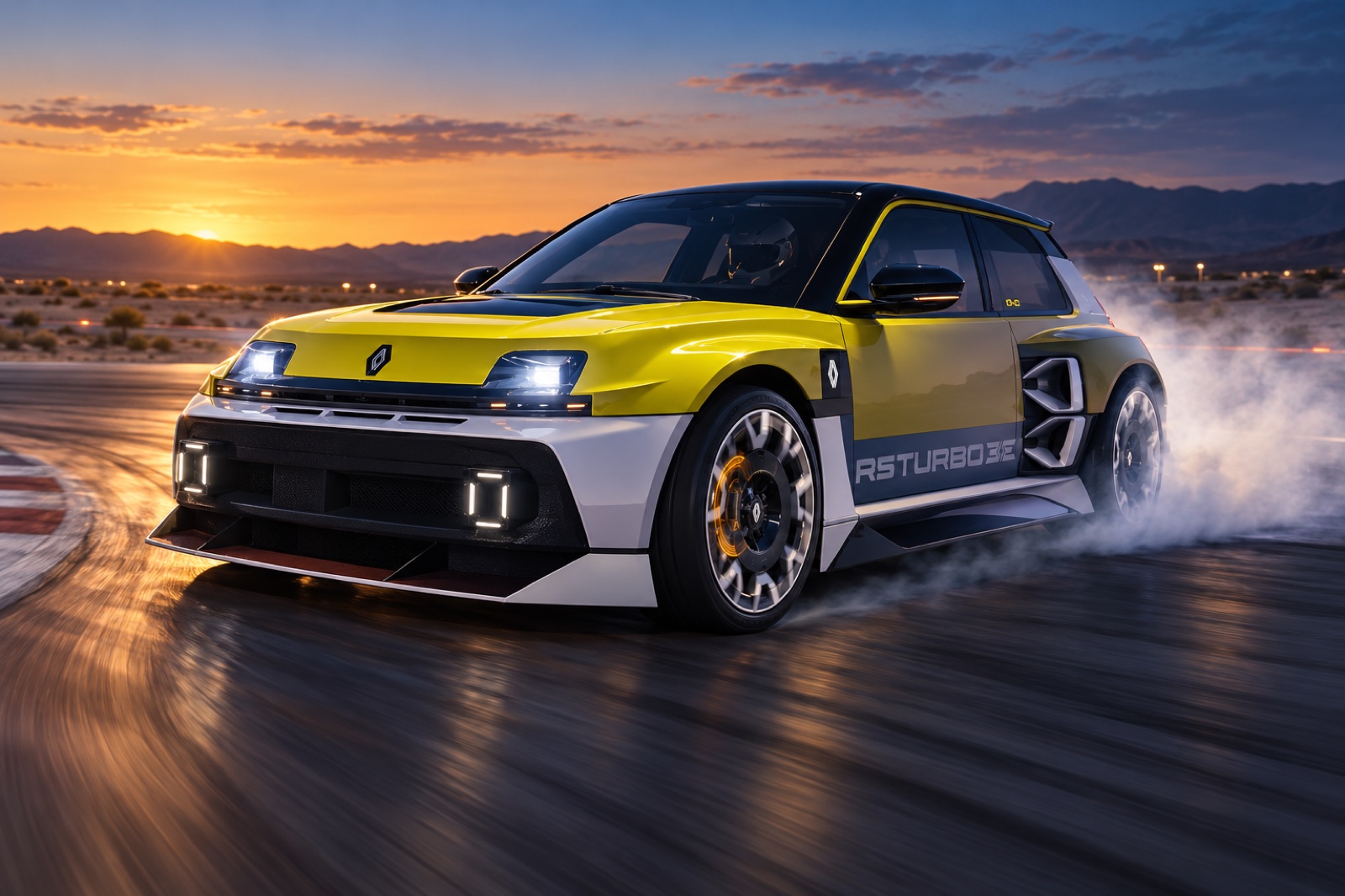
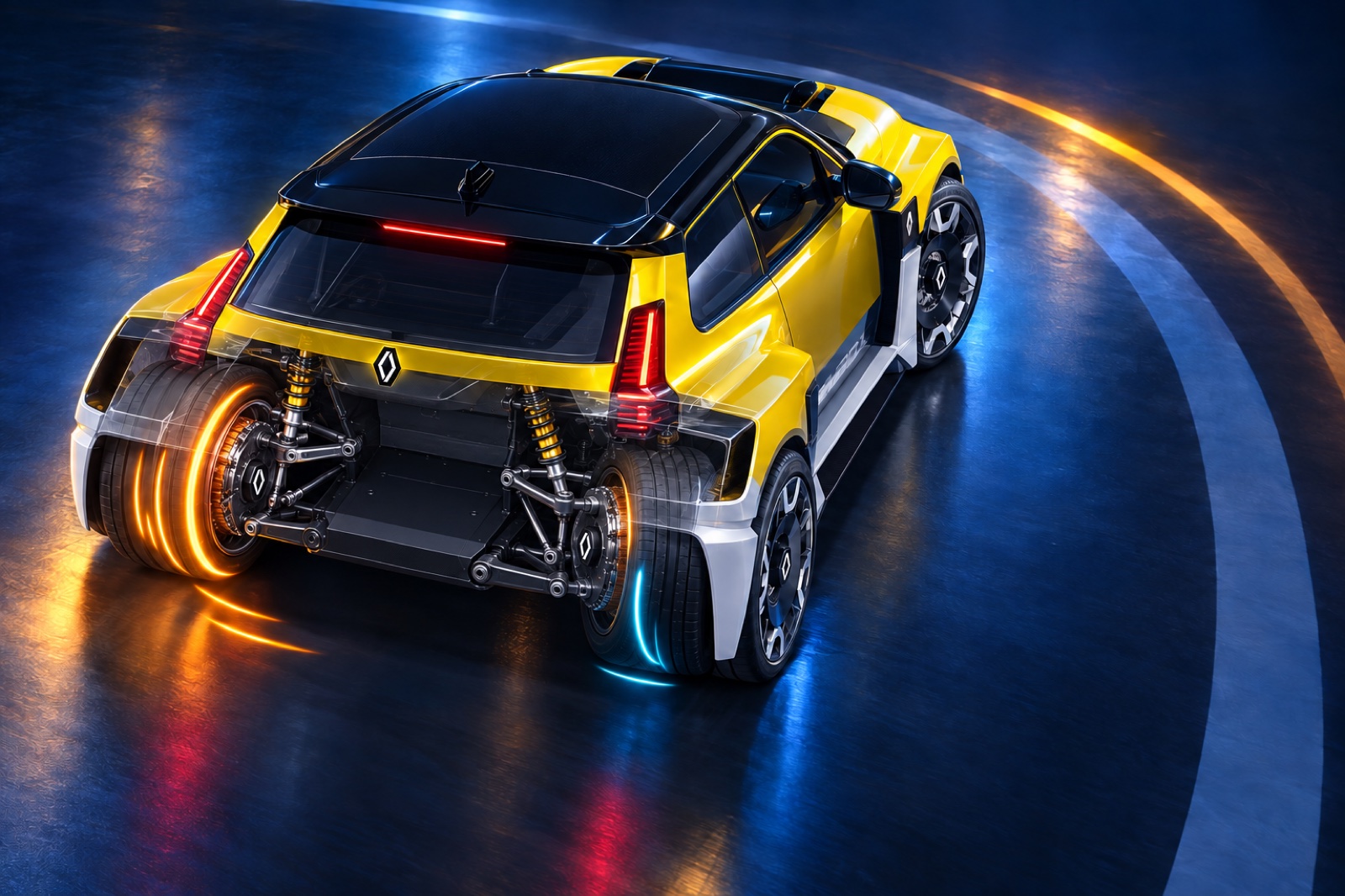
No model is named in the filing. We used the Renault 5 Turbo 3E for the renders because its independently powered rear wheels suit one of the proposed setups, and Renault has said Ampere contributes to its software and electronics. That connection doesn’t confirm this particular system is going into the car.
Correcting The Slide Without Ending It
Drift angle is the difference between where the car points and where it is traveling. The proposed assistance tries to hold that angle near a target while the driver steers through a curve. The target can be fixed or adjustable, with a suggested driver-selectable range of 5 to 25 degrees. Those figures are examples, not universal limits.
Two cooperating software loops manage the task. One regulates how much faster the rear wheels rotate than the fronts, preferably comparing the average speed of each axle. The other estimates the car’s drift angle and decides how that wheel-speed difference needs to change. Accelerator input still contributes to the motor command.
When the car becomes too sideways, the described correction combines outside-front braking with a smaller rear-to-front speed difference. If the angle falls below the target, the controller requests a larger difference to increase the slide. Electric rear drive can use either one motor and a differential or two independent motors.
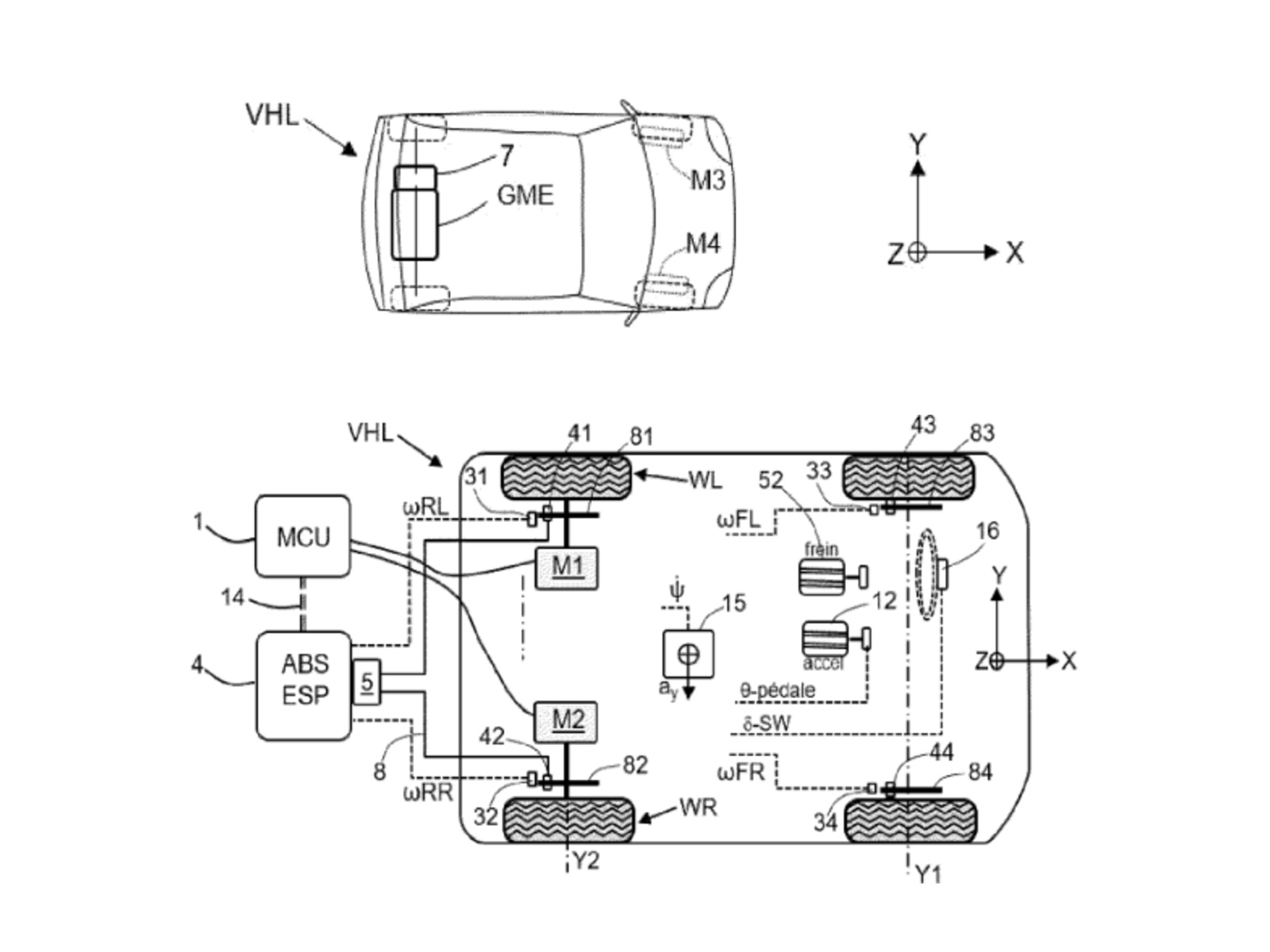
Ordinary traction control and stability-control behavior are temporarily disabled for this deliberately selected mode. Their hardware remains useful. The hydraulic unit normally used for stability control applies the selective brake pressure needed to manage the drift. This is intended for a circuit or other non-public driving area.
The Inside Rear Tire Gets More Spin
With independent rear motors, another adjustment becomes possible. The system can command the inside rear wheel to rotate faster than the outside one. In normal cornering without tire slip, the outside wheel travels farther and turns faster. Here, deliberately adding spin changes the inside tire’s behavior.
Ampere says that extra rotation makes the inside rear tire more prone to lateral sliding, damping fluctuations around the desired drift angle. It is a specific reason to control each rear motor separately, beyond simply dividing propulsion between the wheels.
Knowing the angle requires another calculation. Steering position, vehicle speed and yaw rate, the rate at which the body rotates, feed a simplified two-wheel mathematical model. The software adjusts virtual front and rear steering angles until the model’s rotation matches the real car’s. Its virtual rear-wheel angle then provides the drift estimate.
That rear steering exists within the calculation and does not require a rear-steering mechanism on the vehicle. The approach also avoids needing precision GPS or a magnetic compass. No measured estimation accuracy is provided, leaving an important limit on judging how reliably it would work.
The Driver Still Owns The Steering
The described assistance never commands the front steering. In the example maneuver, the driver initiates the slide with a steering flick and acceleration, then countersteers to sustain it. Reducing countersteer and accelerator pressure begins the exit. Assistance manages the rear drive and selected braking interventions throughout the sustained portion.
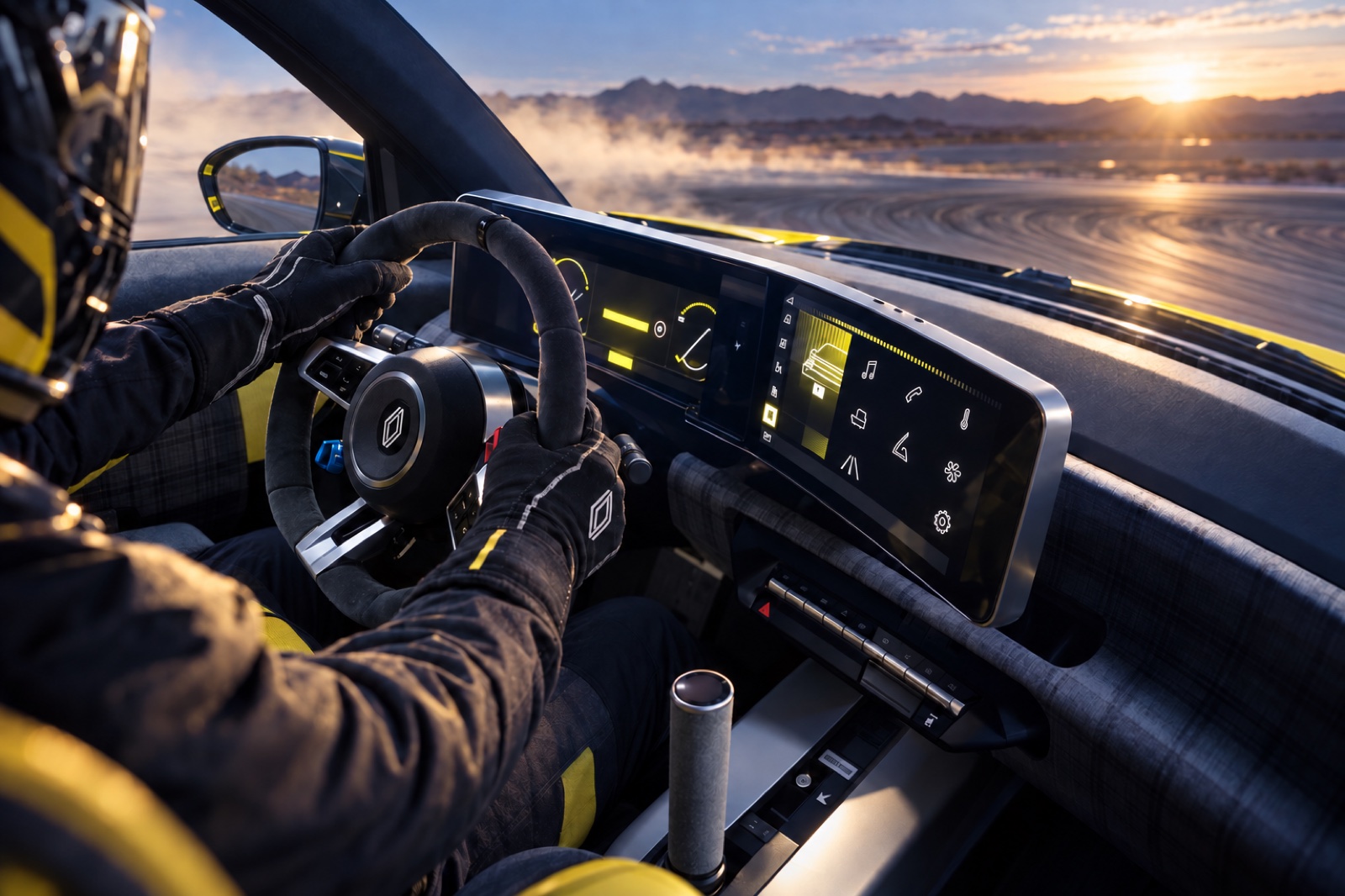
Hyundai already describes its N Drift Optimizer as balancing multiple vehicle controls to help maintain a desired angle based on driver inputs. Assisted drifting is established territory. Renault’s proposal offers a detailed account of how wheel-speed regulation, angle estimation and selective braking can work together, without establishing superiority over an existing system.
A patent does not guarantee production. There is also no measured performance dataset or defined operating-speed envelope here, so the predictability of those corrections remains unproven. The proposal merits development because it addresses the repeated adjustments needed to sustain a slide while leaving the driver responsible for the line through the corner.