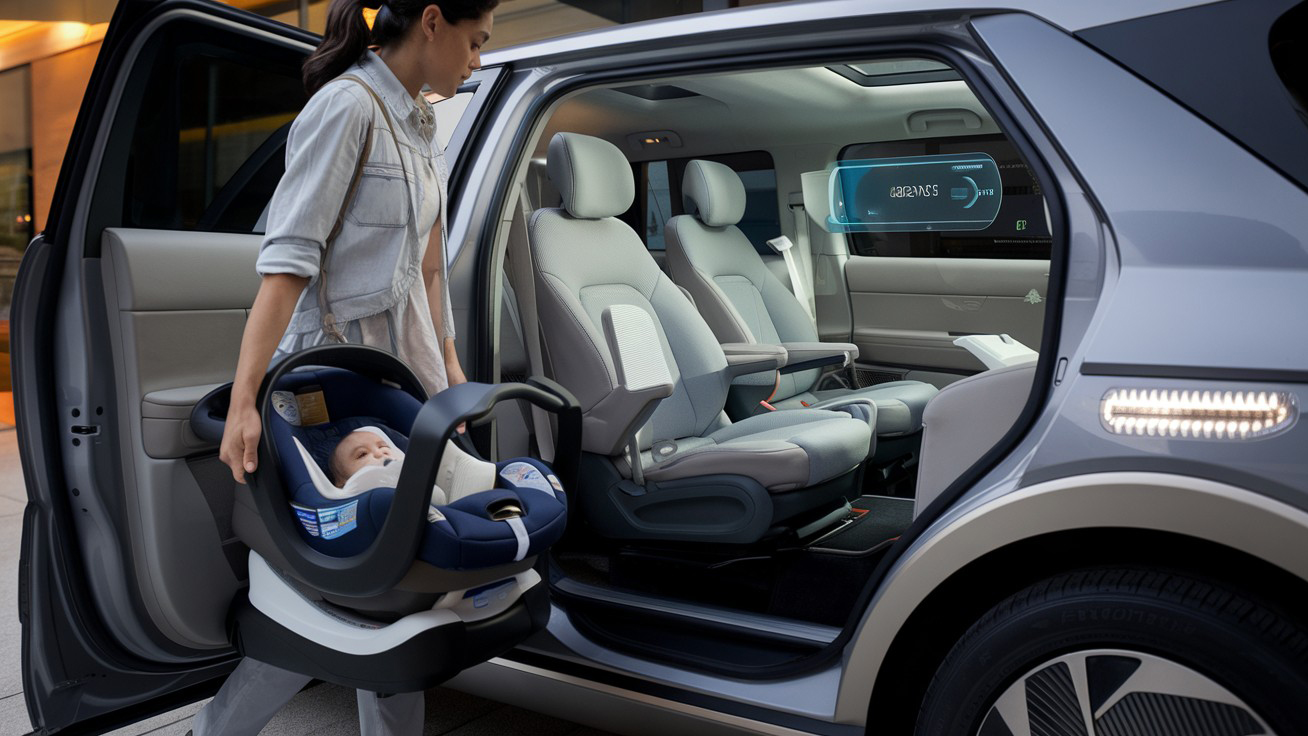
Hyundai Mobis, the beloved South Korean brand’s research and development sub-division, has filed a patent with the European Patent Office for a car that can identify a person with a child seat as they walk up to the vehicle and adapt the interior accordingly.
Hyundai’s Smart Seat Innovation
According to the patent discovered by CarMoses, this is an all-new seat control method that will make life much easier for all the moms and dads out there. If you’ve ever had to carry a booster seat, you’ll know that it’s a cumbersome piece of luggage that’s best left in the car until a child no longer needs it. But this isn’t an option for those who don’t own a car and make use of public transport, and it will become even more of a problem once Hyundai’s fleet of boxy autonomous taxis hits the streets.
Prepping for Families on the Go
It’s important to note that this patent is solely for Hyundai’s fully autonomous vehicles, which will be used as taxis at some point in the future. If you had to fit the booster seat into a traditional taxi, it would take up valuable time, which isn’t ideal as Hyundai plans to run a fleet of cars that can fit multiple people. And people are mostly in a rush. Nobody uses a taxi for fun.
The system is remarkably simple and requires three main elements. First, the system requires an exterior camera that can look at any customers approaching the vehicle. Secondly, it needs an interior full of power-adjustable smart seats. The final requirement is thousands of lines of code to get the first two elements to speak to each other.
Using the camera, the taxi will be able to identify a customer with a booster seat. The camera will also be able to determine the size of the child in question, and how high the bottom of the seat needs to be raised for the safety belt to do its job properly. In theory, at least one of the seats in the taxi will be fully prepped for a child by the time they walk through the sliding door.
Hyundai mentions that its smart seats can adjust the seat bottom, footrest, and seatback, but that’s not all. As you may know, infants require different seats depending on their age. At first, they need a rearward-facing seat until they reach a certain weight, and then they graduate to a tiny seat that looks like it belongs in a Porsche 911 GT3 RS.
The seats in Hyundai’s taxis don’t have that kind of adjustability, but by using the same methods mentioned earlier, these seats can make it easier for a customer to mount the seat without hassle.
Simplifying Travel with Infants
If you’ve ever had to Uber with an infant, you’ll know what a pain it is. Uber does allow you to let a driver know that you have an infant with you and that you’re going to be using either a booster or infant car seat, but it doesn’t solve the problem as such. You still have to struggle to get the child in whatever vehicle arrives to pick you up. In our experience, some Uber drivers will even avoid somebody traveling with a child.
Hyundai’s system is brilliant because it already preps the car as you walk up to it, so there’s no need to struggle to find the right seating position, possibly holding other people up who also want to complete their journeys.
It’s also nice to know that Hyundai is finding solutions for taking care of the most precious cargo in the world, and we hope to see this implemented not just in its autonomous taxis, but also in some of its more family-friendly cars like the three-row Palisade.