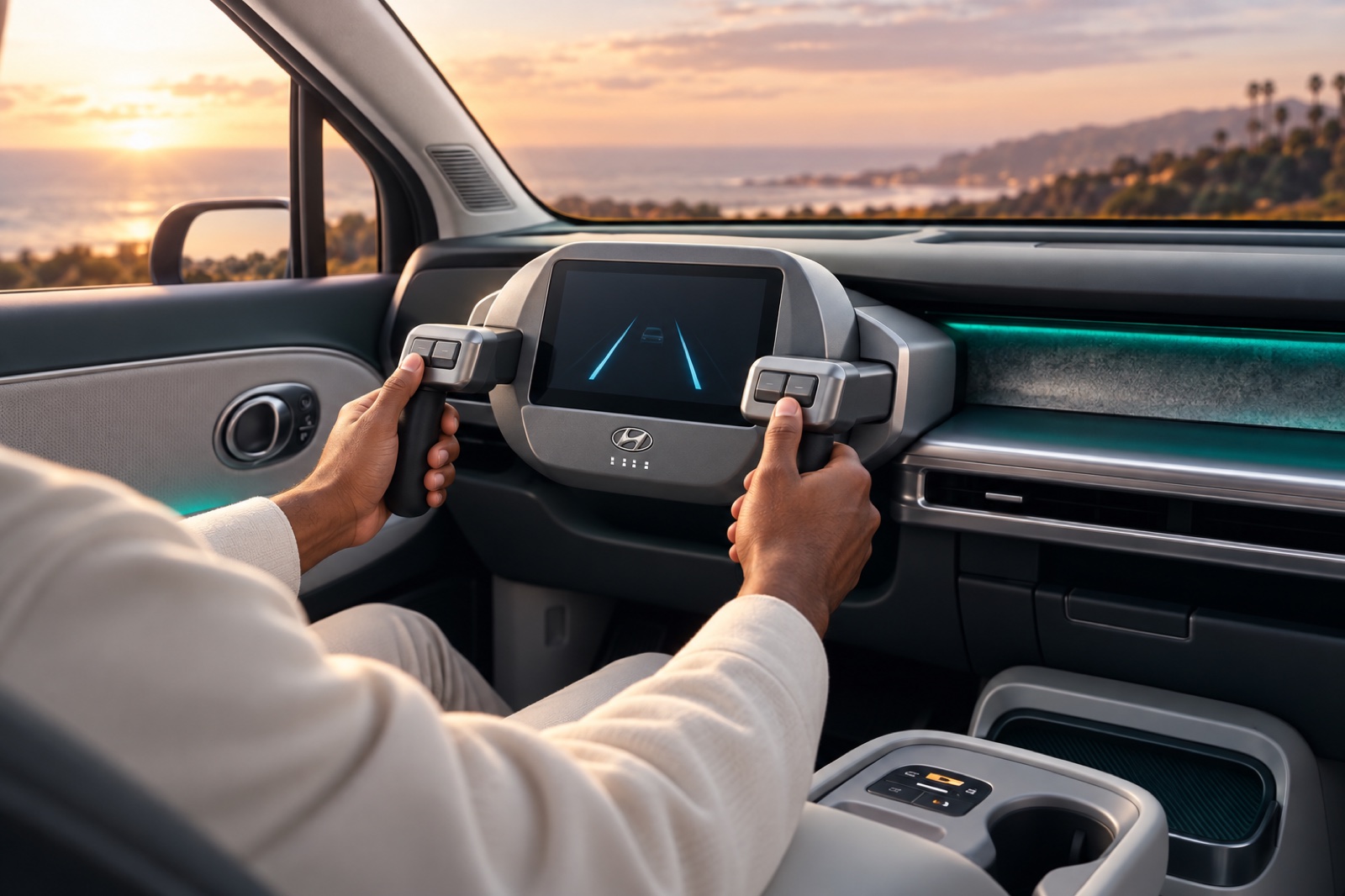
Hyundai has proposed replacing the traditional steering wheel and pedals with two folding hand grips. The controls handle steering, acceleration and braking, then disappear behind the dashboard screen when the car is driving autonomously. When the driver takes over again, the screen lifts and the grips fold back into position.
The arrangement appears in a patent filing discovered by Carmoses from Hyundai, Kia and supplier LS Automotive Technologies, published this month. It combines the controls and display in one dashboard-mounted assembly, hiding the grips during autonomous driving to free cabin space and prevent unwanted inputs.
Hyundai already showed a retractable driving stick in its SEVEN concept in 2021. The development here is a specific mechanism for folding paired controls behind a screen, then bringing them back into a position suited to driving.
Nothing in the filing names a model. The renderings place the module in the US-market Ioniq 9 because Hyundai explicitly connects that SUV’s lounge-inspired cabin to the SEVEN concept.
The Screen Opens Before The Grips Emerge
When the system receives a signal to switch from autonomous to manual driving, a motor tilts the display upward around its upper edge. This opens the compartment containing the folded hand controls. Separate motor power swings both grips outward until the distance between them exceeds the screen’s width.
The display then lowers to close the compartment. Only afterward do the handles move inward to their driving positions. That temporary spread prevents a collision with the moving panel and allows a larger display without forcing the driver to hold the controls equally far apart.
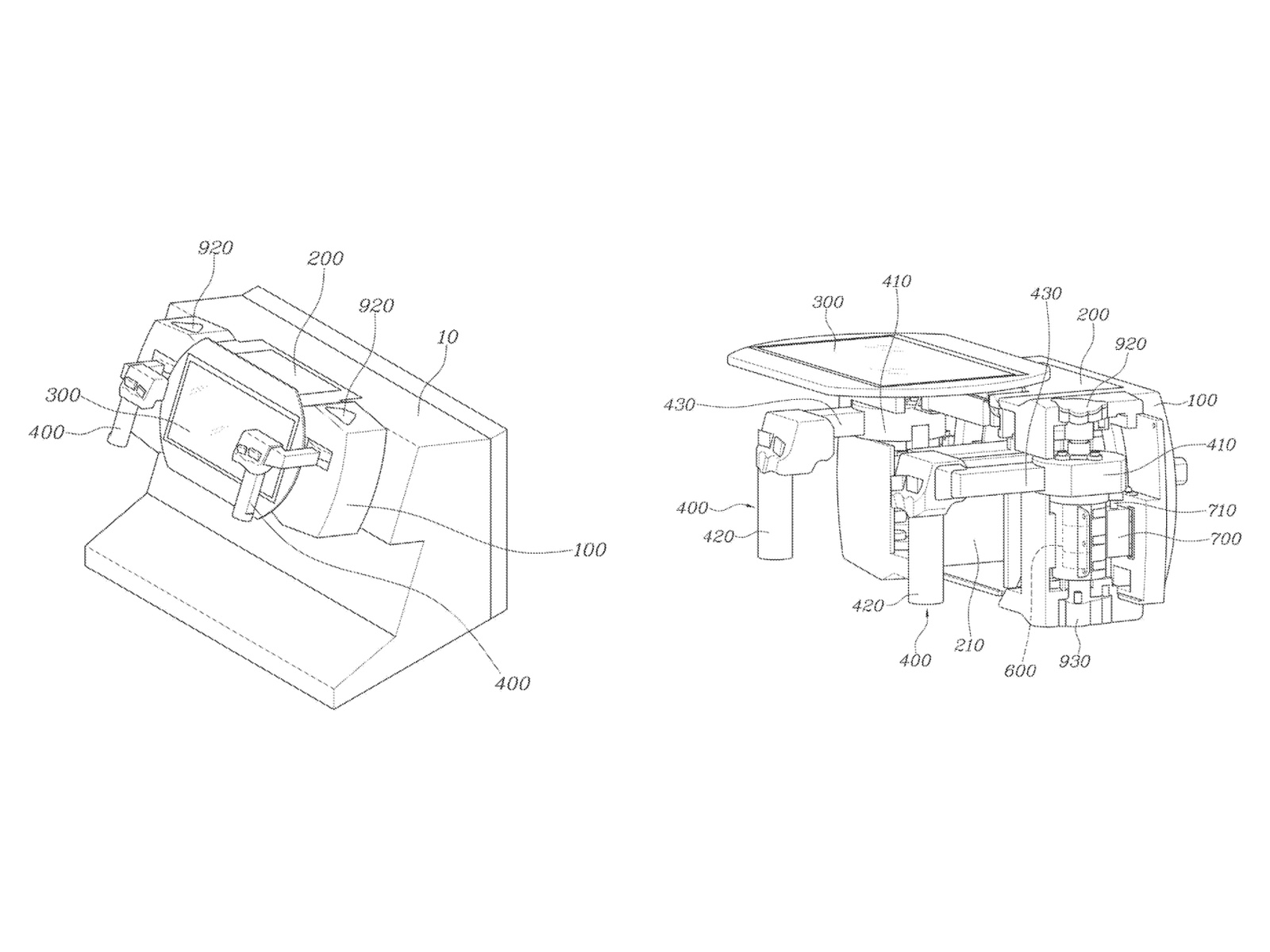
Stowing the assembly uses the same clearance principle. The handles spread, the screen lifts, the controls fold into the cavity, and the lid closes. Hinges at the top keep the opening panel from swinging downward toward the driver’s hands or body.
Two sets of locks do different jobs. Electrically operated pins secure the folding joints so the grips remain rigid during use. A separate pin holds the surrounding steering housing still while the assembly transforms, then releases it for manual steering.
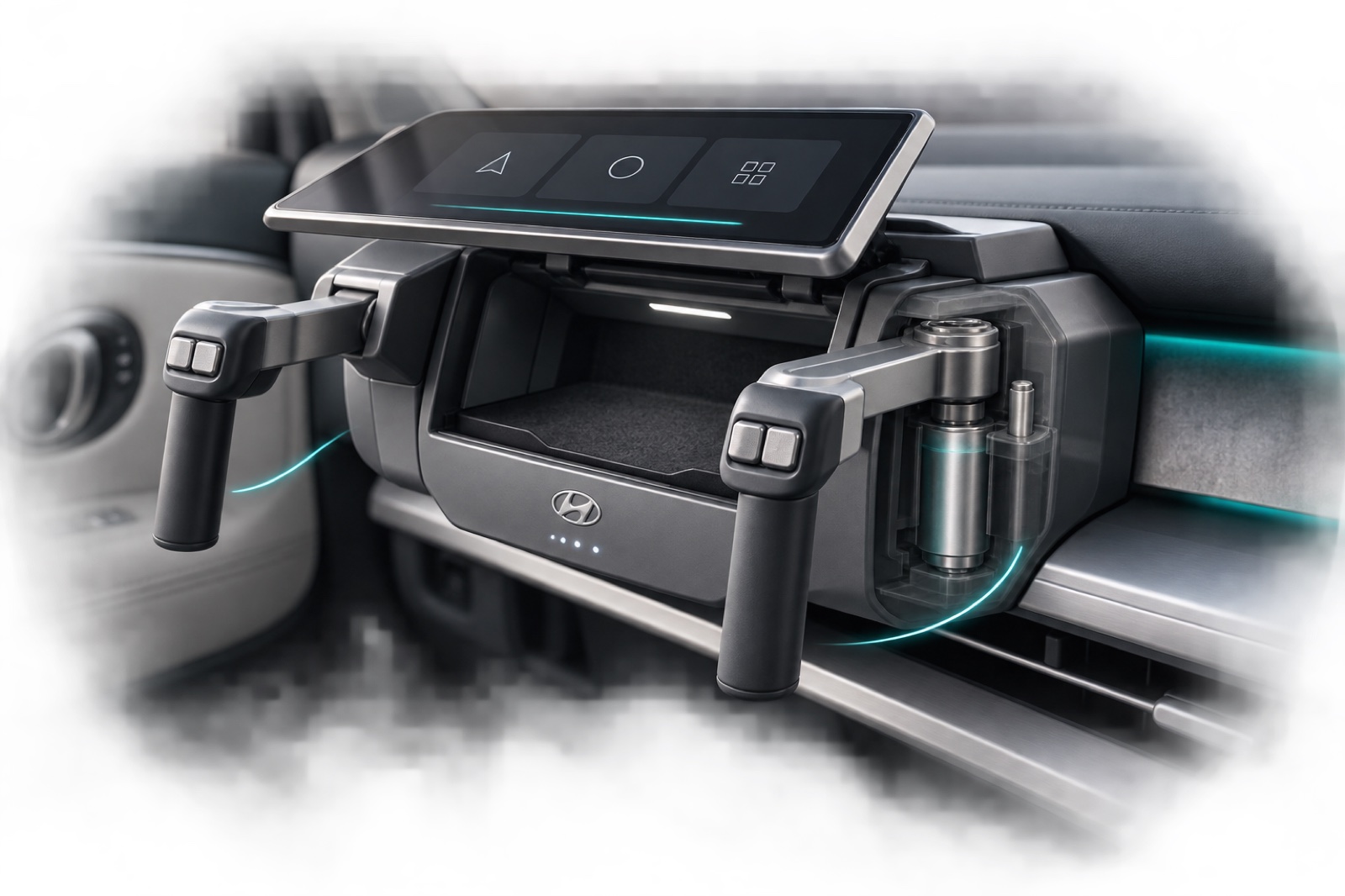
Grip spacing can be adjusted again after deployment. Three overlapping locking grooves accommodate narrower, middle and wider positions, although no dimensions are given.
The Display Stays Level While The Hands Turn
The handles may look like paired joysticks, but the driver steers by turning their common surrounding housing clockwise or counterclockwise. They do not independently tilt to direct the car. The screen attaches to a fixed central structure, keeping it upright as the assembly around it rotates.
A return spring can bring the steering housing back to neutral when released. Sensors detect changes in magnetic fields as the controls move, and the electronics pass steering, acceleration and braking signals to the vehicle controller.
Each grip can carry both an accelerator button and a brake button, positioned for thumb operation while the hand holds the handle. The functions are duplicated on both sides rather than divided into a dedicated throttle grip and a dedicated brake grip.
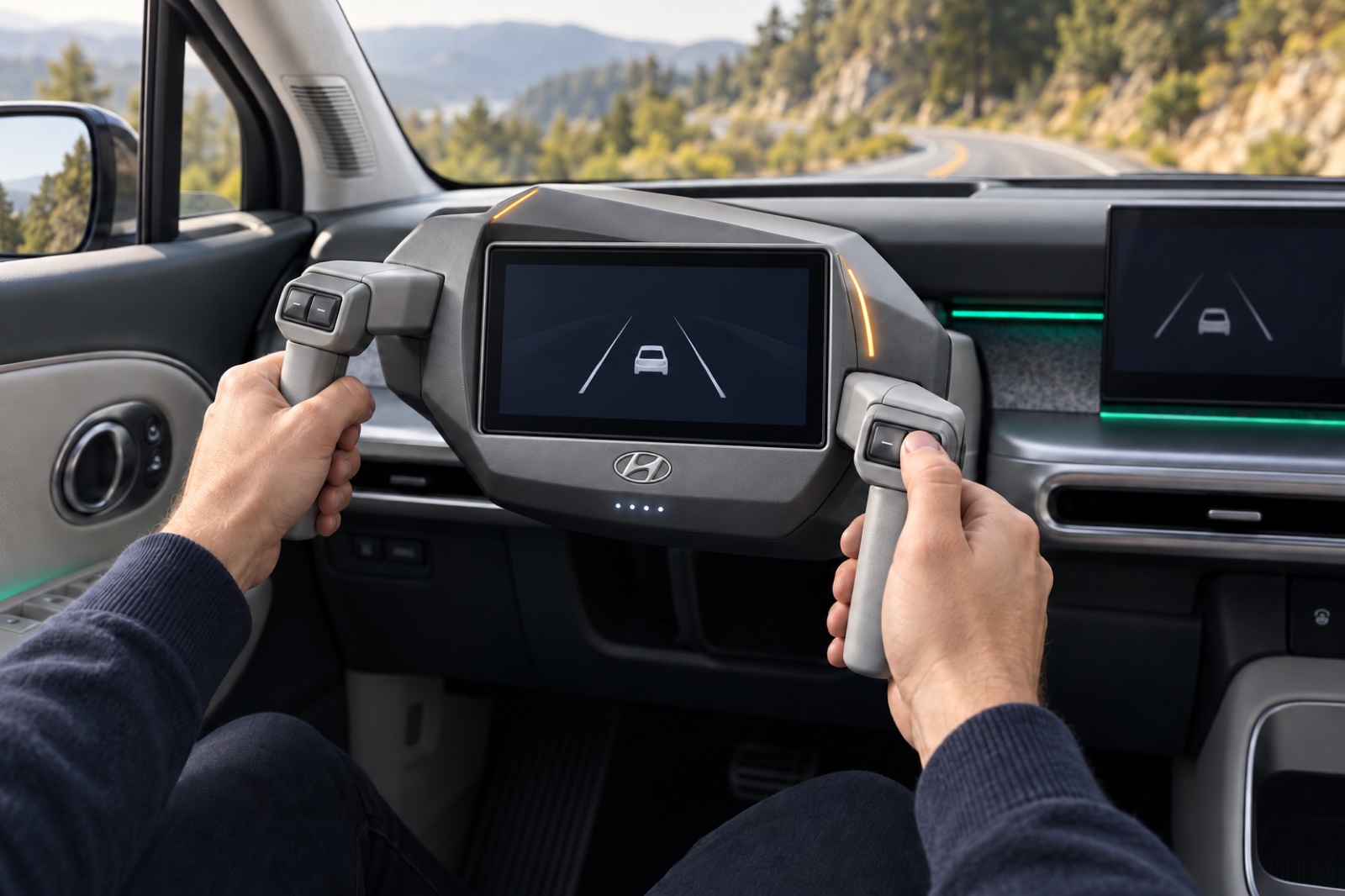
That concentrates several driving tasks at the hands. Button travel, resistance and the ability to distinguish acceleration from braking by touch would matter as much as the folding hardware. The description supplies no driver-testing results to establish how intuitive this arrangement would feel.
A Clearer Dashboard Still Needs A Reliable Handoff
Lexus has introduced steer-by-wire for the European RZ while retaining a steering wheel and pedals. Hyundai’s proposal changes more of the driver’s routine by putting acceleration and braking at the thumbs, then storing the grips behind the display.
The proposed autonomous mode assumes the car can drive while its manual controls are concealed. It should not be confused with the driver assistance available in current retail vehicles. The display would provide entertainment during autonomous travel and vehicle and surroundings information during manual driving.
The packaging argument is credible. A single module offers a defined place to store controls, keeps the display upright during steering and lets hand spacing change without dictating screen width. Hyundai also proposes weight and cost benefits from integration, but provides no measurements to support them.
A patent does not guarantee production. More consequential gaps remain in the filing, including deployment time, airbag placement and what happens if a motor or locking pin fails during a handoff.
This is a convincing answer to how driving controls could disappear behind a larger screen. Before it becomes a convincing replacement for a steering wheel and pedals, Hyundai needs to establish how quickly and reliably those controls return when the driver needs them.