A holographic windshield display can lose color alignment as its laser sources warm or cool. Hyundai Mobis proposes switching to another emitter with a slightly different wavelength, aiming to keep those graphics properly aligned and consistently bright. The useful addition would be something the driver never has to operate.
The approach appears in a patent filing discovered by Carmoses. Instead of relying on one light source for each color, the supplier describes multiple alternatives with closely spaced wavelengths, including four in its blue-light example. A controller would choose the source that matches the optical film inside the windshield.
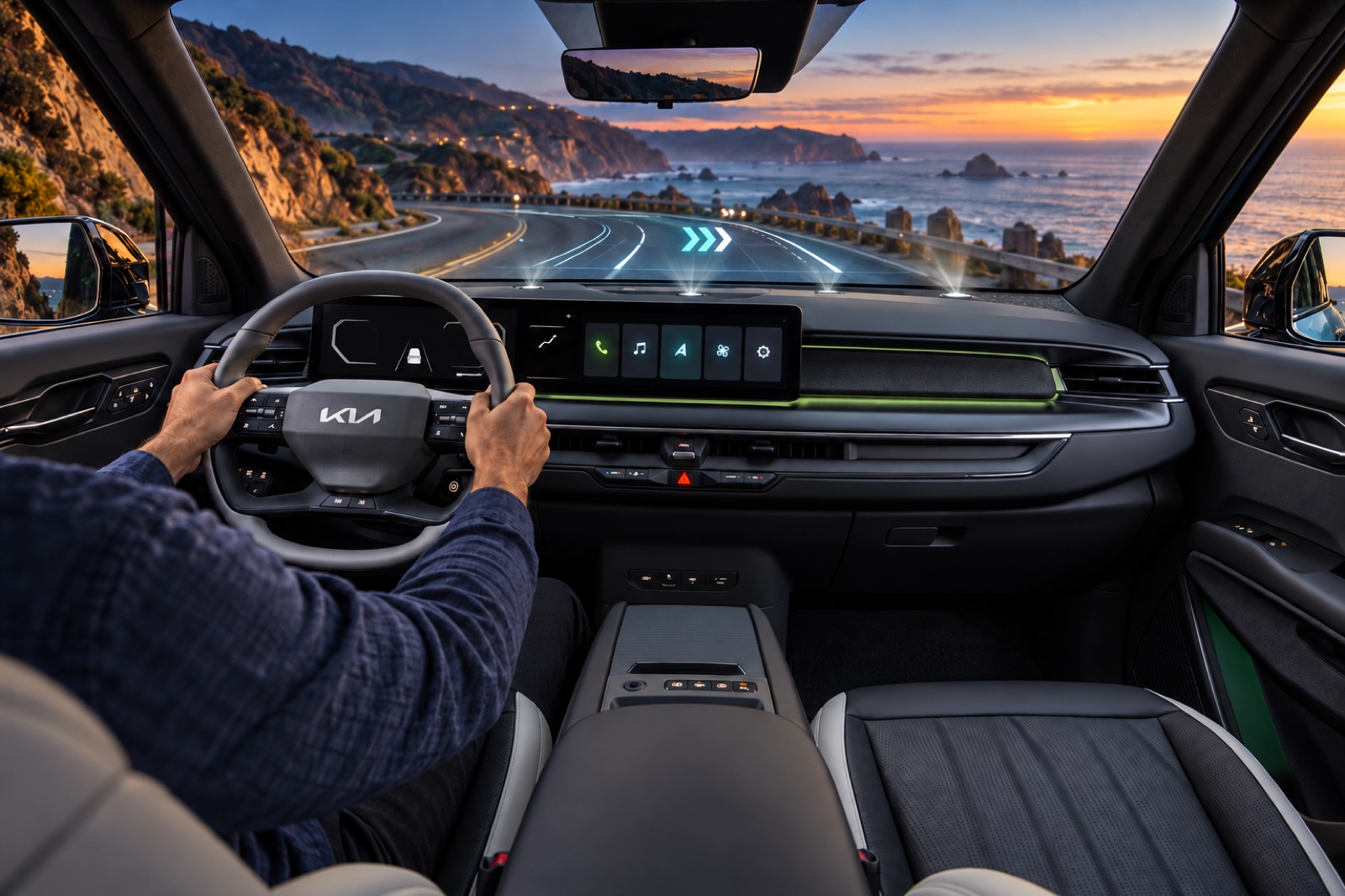
Mobis already demonstrated a holographic windshield display in a Kia EV9 at CES last year. The filing names no model, but that public demonstration makes the US-market SUV the strongest setting for the renders here. They place the proposed hardware in an EV9 cabin without establishing a future Kia option.
Why The Colors Move
The windshield contains a holographic optical element, a patterned film that redirects projected light toward the occupants’ eyes. Its response depends on both the angle at which light arrives and its wavelength. Matching those properties lets the film direct the image efficiently toward the viewer.
Temperature complicates that relationship. A laser’s wavelength can shift as conditions change, causing the film to send light in a different direction even though the projector has not moved. The red, green and blue sources can respond differently to the same temperature change, so their contributions to the image no longer line up.
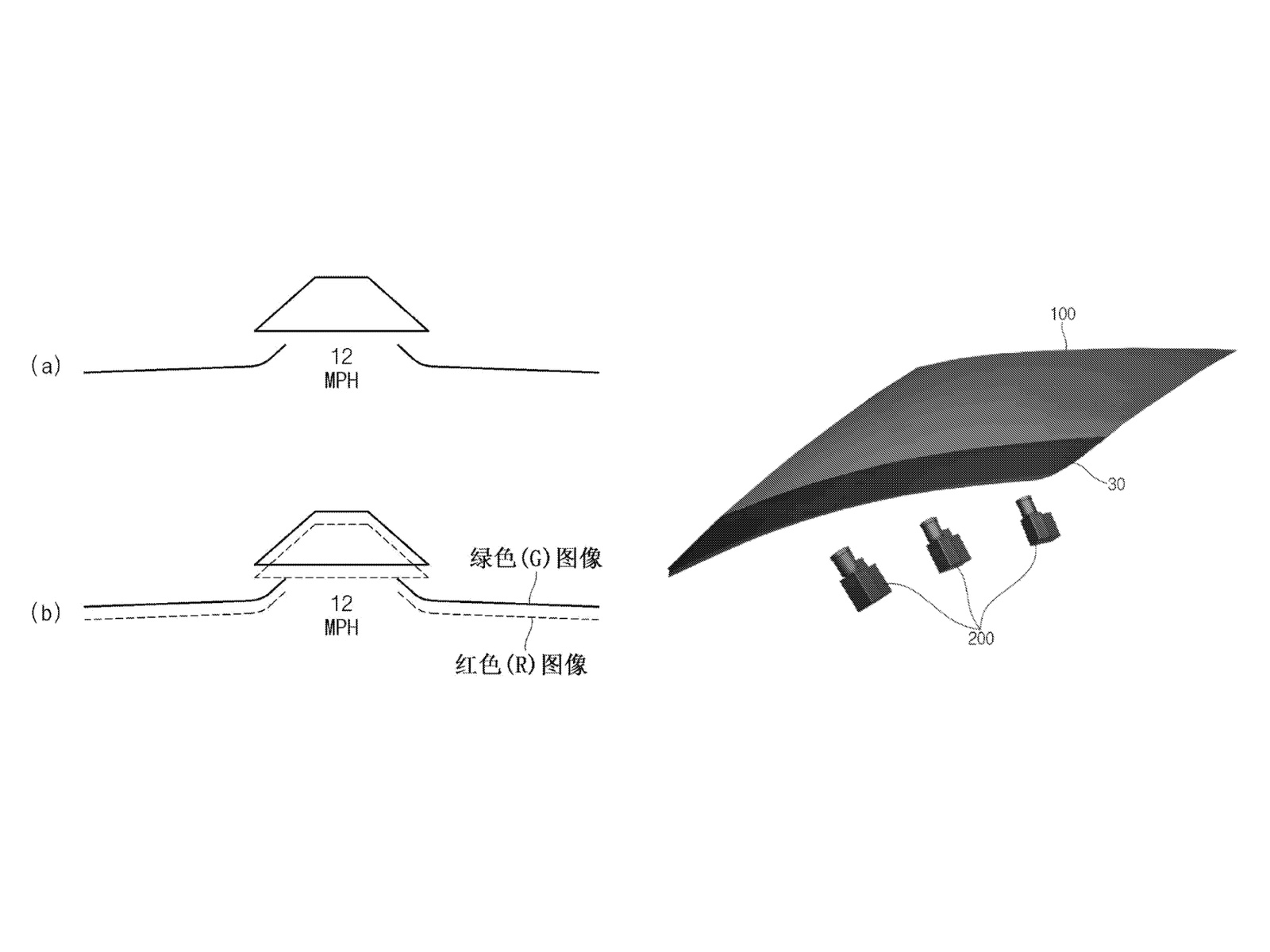
The result can be a red outline displaced below a green one. Unequal changes in how efficiently the colors reach the viewer can also upset white balance and reduce brightness. This is an optical problem that reaches beyond whether the navigation software has drawn a crisp icon.
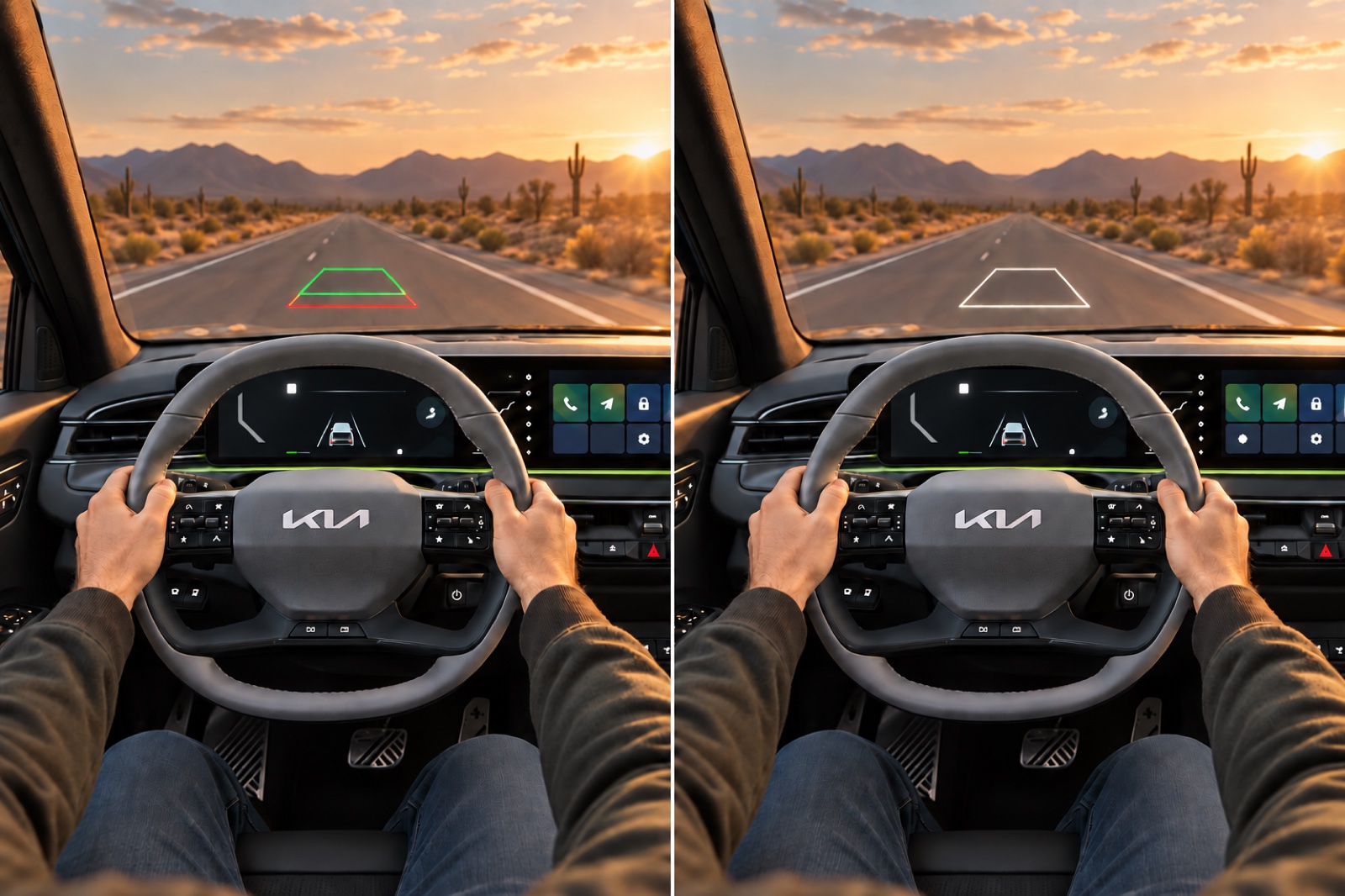
For the driver, the intended behavior is straightforward. Keep using the display while the electronics monitor the light-source modules and select a suitable replacement emitter when conditions change. There is no proposed calibration gesture or color adjustment for the person behind the wheel.
Four Choices Within One Color
Mobis describes monitoring temperature, wavelength or both. A stored lookup table can tell the controller which source to activate for the detected condition. It can then stop driving the emitter whose output has shifted and select another whose central wavelength matches the film’s optical requirements.
The blue-module example contains sources at 400, 403, 406 and 409 nanometers. Those are example values, with three-nanometer steps, rather than a production specification. The proposal also describes spacing between two and 10 nanometers, and it does not limit every module to four emitters.
These are alternatives within a color channel. Selecting another blue source changes the wavelength feeding that channel while preserving its role in the full-color image. Light passes through illumination optics to the image-forming display, then through projection optics to the windshield film.
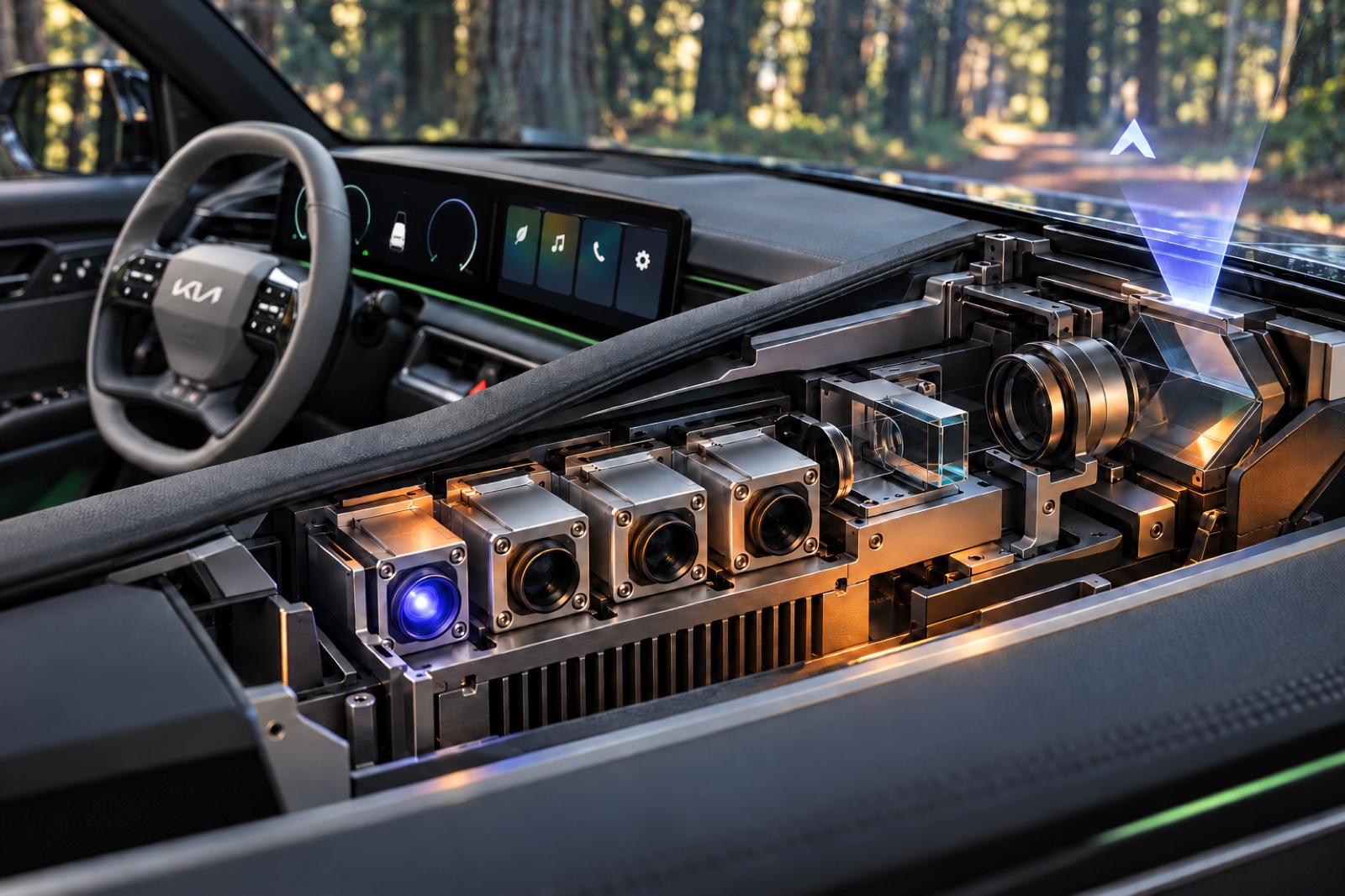
One installation uses three projectors beneath the windshield, although the number can vary. The film and projection hardware work together, so this is a system involving the glass as well as the dashboard electronics.
The Test Is Consistency
The broader market is already moving information toward the base of the windshield. BMW’s Panoramic Vision projects onto a black printed surface across the lower glass. Mobis’s holographic approach uses transparent optical film to redirect the image. The similar placement conceals a meaningful difference in how the driver receives the light.
Today’s US-market EV9 offers an available 12-inch head-up display. The proposed system would instead use the windshield’s optical film to guide projected light. Earlier this year, Mobis announced an alliance with ZEISS, tesa and Saint-Gobain Sekurit targeting commercialization of its broader holographic windshield technology by 2029.
What remains unproven is how smoothly the source handoff would work. The filing gives no switching-time results or measured improvement in brightness and color alignment. It also leaves the cost, power consumption and final emitter count unresolved. A patent does not guarantee production.
This is a worthwhile refinement because it addresses whether windshield graphics remain readable as operating conditions change. The engineering case is stronger than another promise of a bigger display area. Before this approach earns a place in a showroom, Mobis needs to demonstrate that changing emitters preserves the image without a visible interruption.