
Mercedes has a new proposal for squeezing an electric motor and a friction brake into the same wheel, with much of the work handled by a part that never turns. A patent filing discovered by Carmoses describes how a shared support can hold the motor and brake hardware together to make the assembly more compact and lighter. The interesting detail is how it holds everything still while the wheel rotates around it.
Mercedes has already made wheel-motor designs with integrated brakes public, including an earlier proposal pairing an inner-rotor motor with a drum brake. This latest approach changes the mounting layout and describes an outer-rotor version with the braking hardware tucked inside the motor’s ring.
Nothing in the filing names a model. The electric GLC serves as the showcase here because Mercedes has scheduled it for the US market this year. The GLC 400 4MATIC Electric actually uses front and rear axle drive units, including a two-speed transmission at the rear.
A Brake Inside The Motor
The basic job remains familiar. Acceleration requires the electric motor to turn the wheel. For friction braking, a shoe presses against a drum that rotates with it, slowing the assembly. Hydraulic operation is one possibility Mercedes describes. There is no new driver control specified, or explanation of how regenerative and friction braking would be coordinated.
The unusual part is the arrangement around the hub. The stator, the stationary part containing the motor windings, forms a ring. Outside it sits the rotor, which turns and connects through its supporting structure to the wheel and rotating bearing race. The brake drum occupies the smaller diameter inside that stationary ring.
Crucially, the drum also overlaps the stator across the width of the wheel. That means the two systems can occupy some of the same space from side to side, instead of requiring their full widths to be stacked beside each other. It is a packaging solution with a clear physical logic, even though Mercedes supplies no dimensions for the resulting unit.
One Support, Three Attachment Zones
Packing those components together leaves another problem. The motor’s fixed section and the brake-shoe holder both need secure connections to the vehicle, while the drum and rotor must remain free to spin.
Mercedes puts a shared, roughly plate-shaped support on the vehicle-facing side of the assembly. Closest to the wheel’s center, it connects to the wheel carrier. Farther outward, it carries the brake-shoe holder. At a still larger radius, it carries the cylindrical support for the stator.
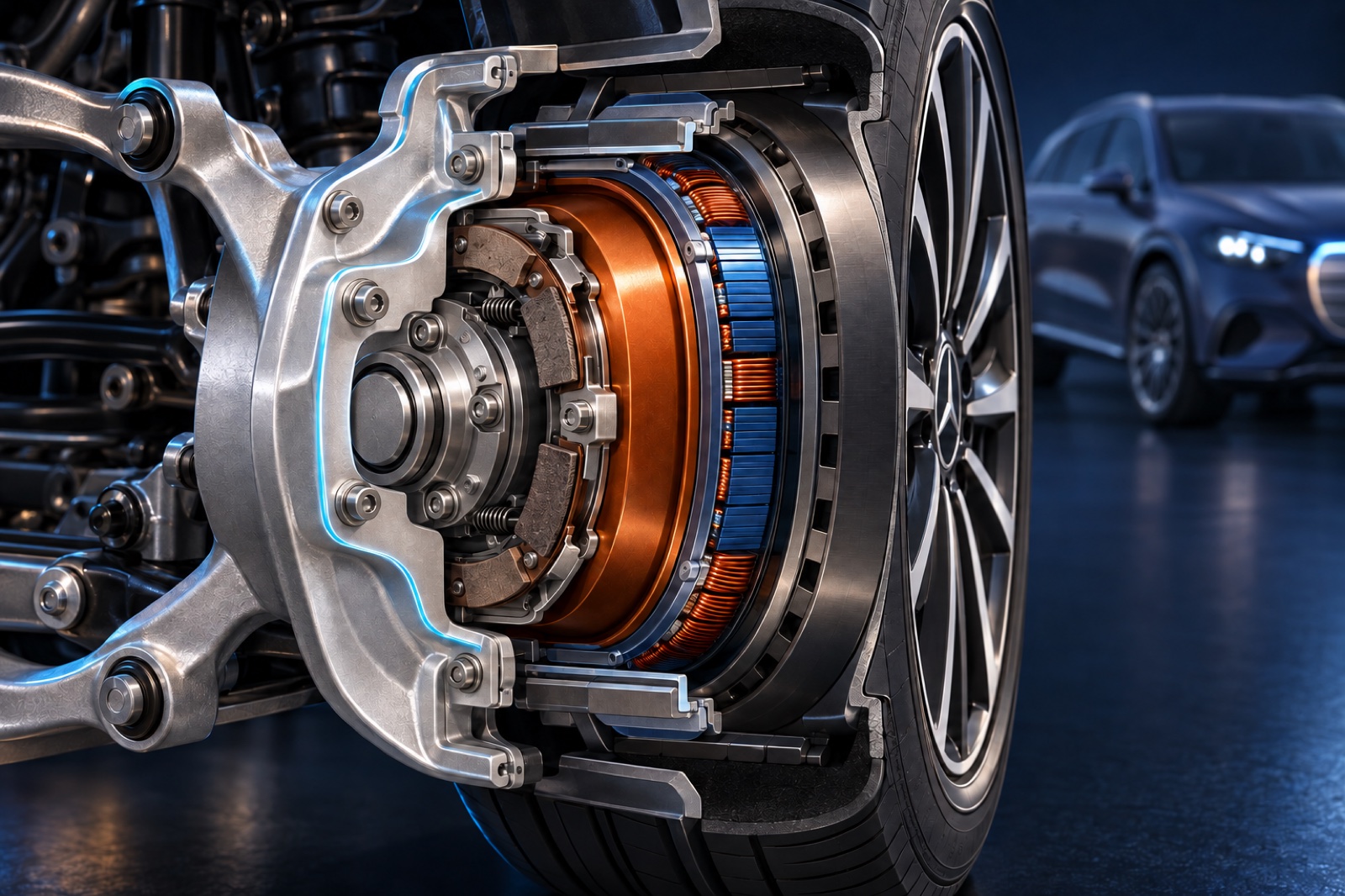
Those are three attachment regions at increasing distances from the axis, rather than three fasteners doing the same job. The shoe can move against the drum without rotating around the hub, and its braking forces pass through its holder into the shared structure. The motor’s stationary section has its own attachment farther out on that same backing piece.
There is flexibility in how the assembly is made. The brake-shoe holder can bolt to the support, or an axial spacer can be formed as one piece with it. The stator’s cylindrical carrier can also be integral with the backing structure or separately attached. Mercedes presents these choices as ways to achieve favorable packaging and weight, without quantifying either advantage.
A Cover That Moves Against Its Seal
The outer rotor’s housing includes a removable cover on the vehicle-facing side. Screws attach it to the surrounding housing, and a seal bridges the boundary between that rotating cover and the fixed stator support. In the described arrangement, the seal travels with the cover and slides over the stationary cylindrical surface.
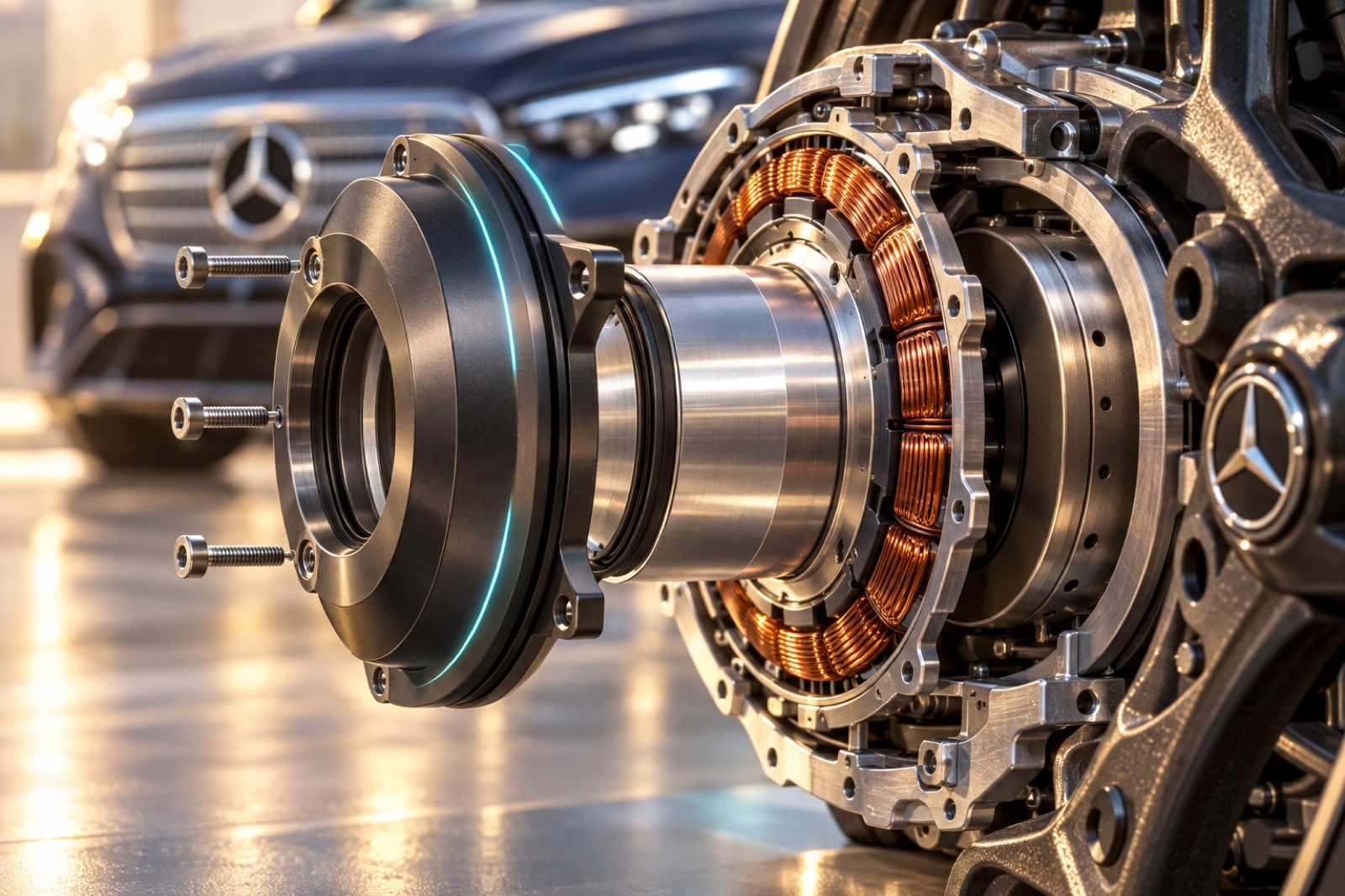
That is a useful construction detail, but a removable cover alone establishes neither inexpensive brake servicing nor lifetime sealing. The filing does not provide a cooling layout, durability results, motor output, or measured weight reduction. A patent does not guarantee production.
There is established competition in this space. Continental and DeepDrive previously announced a joint wheel-mounted drive-and-brake unit, and DeepDrive describes an integrated drum brake for its in-wheel system. Combining propulsion and friction braking is already a development field with multiple participants.
Mercedes’ contribution is a specific way of supporting those tightly packed components. It is a credible packaging proposal. Its value to a buyer still depends on measured weight, heat management, and durability, which would make a stronger case than compactness alone.