
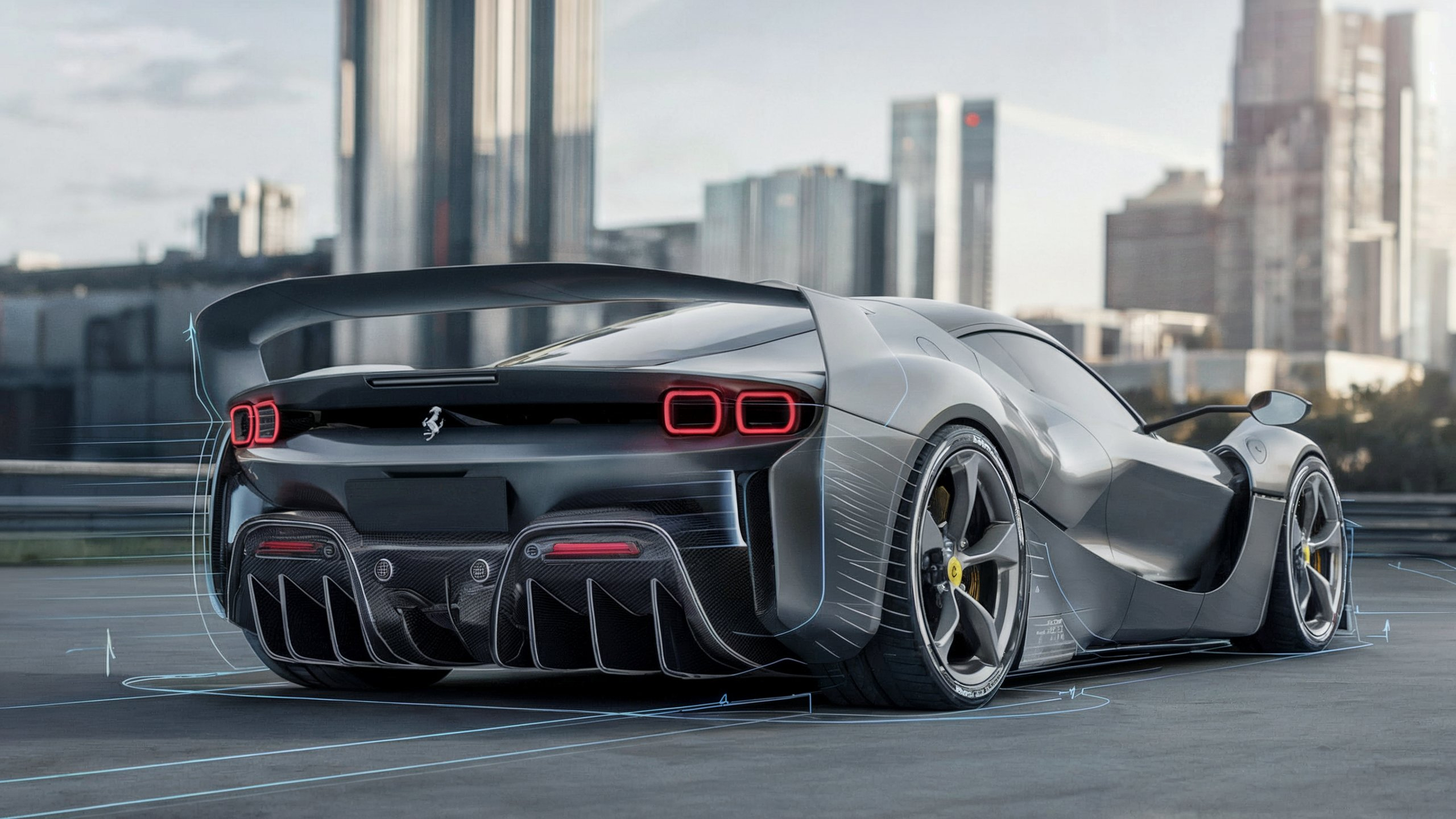
Like it or not, every automaker is developing an EV, even Ferrari. But if a patent discovered by CarMoses filed with the European Intellectual Property Office (EUIPO) is anything to go on, Ferrari is deploying all of its engineering might into the first electric Prancing Horse.
The patent describes a new battery configuration within the floor of a hybrid or electric sports car. Unlike traditional floor-mounted batteries that lay flat in a skateboard chassis this one is curved as the battery design aims to mimic a traditional underfloor diffuser to enhance the car’s aerodynamics.
The Problem To Be Solved
Often, sports cars will employ angled floors at the rear to create a negative pressure zone that sucks the car to the road surface. This is commonly referred to as “ground effects” and is used in contemporary Formula 1 cars and a plethora of other high-end machinery. With a traditional battery pack of completely flat construction, the only way to achieve this is by angling the pack and adjoining it to the front portion of the vehicle’s floor at an angle.
The problem with this is that the sudden change of direction between two surfaces – even by as little as 5 degrees – creates a point at which the airflow separates from the underbody surface, effectively mitigating the suction the angled floor is intended to create.
Cylindrical Battery Cells And A Curved Floor
In Ferrari’s patent, the automaker describes a curved battery pack raising further from the ground the further towards the rear of the car it gets, while maintaining a parallel height to the battery structure from front to rear.
Key to this is the implementation of cylindrical battery cells as opposed to more traditional pouch cells. Pouch cells are limited in how they can be stored, usually stacked alongside one another. With the cylindrical cells lying flat on their sides, Ferrari can stack these cells in a pattern that allows for greater fluidity. Think of this like laying a bunch of soda cans on their sides, where even if the floor of the container you stack them in is uneven, they can accommodate variances accordingly.
By creating an underfloor that curves from being parallel to the road surface to angled upwards and away from it, Ferrari can maintain laminar flow under the body, and create aerodynamic downforce “which enables increasing the rear load of the road vehicle.”
Overall, this leads to improved grip, cleaner airflow, and reduced drag, with an overall increase in lift-to-drag.
Multiple Uses For Different Drivetrains And Powertrains
The patent describes traditional battery chemistry, such as lithium-ion, so it doesn’t break the mold in that particular area. But importantly, Ferrari stipulates that this technology could be applied to various vehicle configurations. The patent specifically notes that it’s applicable to both hybrid and battery-electric vehicles, and that the drivetrain can be either rear- or all-wheel drive.
The curved battery pack itself forms part of the chassis, making it a structural member and thus allowing Ferrari to reduce the overall chassis weight, while simultaneously improving aerodynamics.
As for when it might be seen, because it’s not explicitly reserved for EVs, we may see this in a future embodiment of a sports car like the 296 GTB or SF90 Stradale replacement, or better still, Ferrari’s forthcoming rival to the McLaren W1.