
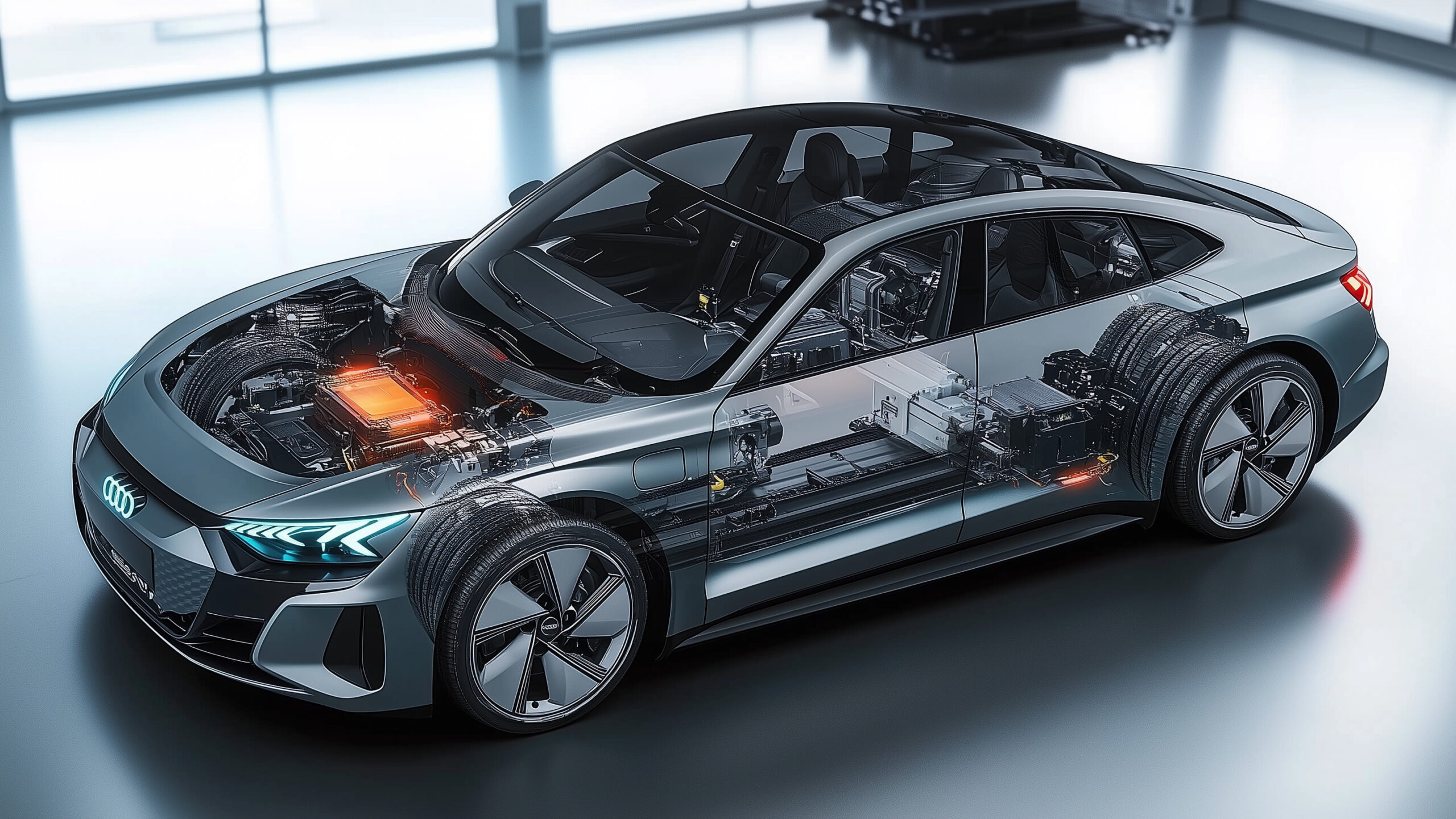
Audi may have found a breakthrough in EV battery design. A new patent filed with the European Patent Office reveals that the automaker is working on an innovative printed circuit board (PCB) for battery modules, aimed at reducing complex wiring systems in electric vehicles. While combustion cars have long settled on optimal design principles, EV technology is still evolving, with automakers racing to refine their engineering approaches. Audi’s new PCB system could streamline battery architecture,enhancing efficiency, reliability, and scalability in future EVs.
Out With Wires, In With Circuit Boards
Audi says that it will use additive manufacturing techniques to mass-manufacture the circuit boards it says promises a range of key benefits:
- Built-in sensors for real-time battery monitoring
- Lower production costs
- Simplified design for easier manufacturing
- Greater efficiency & reliability
- Lighter & more compact for better vehicle performance
- Direct integration onto the battery cell housing
Seamless Integration for Smarter Batteries
The circuit board has built-in sensors that measure battery cell data and send it to a control unit, allowing for real-time monitoring, optimization, and control without the need for complex wiring. Using additive manufacturing, the printed circuit board is applied directly to the housing wall on an electrically insulating material that serves as its carrier. This method eliminates additional wiring, as well as the need for several components and assembly steps, with clear advantages in efficiency, complexity, and cost management.
A Game-Changing Approach to Battery Design
What sets this patent apart is its innovative combination of features: a special backing surface, an integrated sensor array, and a streamlined assembly process with fewer components and minimal wiring. Audi’s design is currently the only known patent that:
- Uses additive manufacturing techniques
- Applies the circuit board directly to the battery housing wal
- Leverages a newly developed backing surface for stability
This approach not only cuts costs but also boosts battery efficiency and enhances manufacturing scalability, making it a potential breakthrough in EV battery technology.