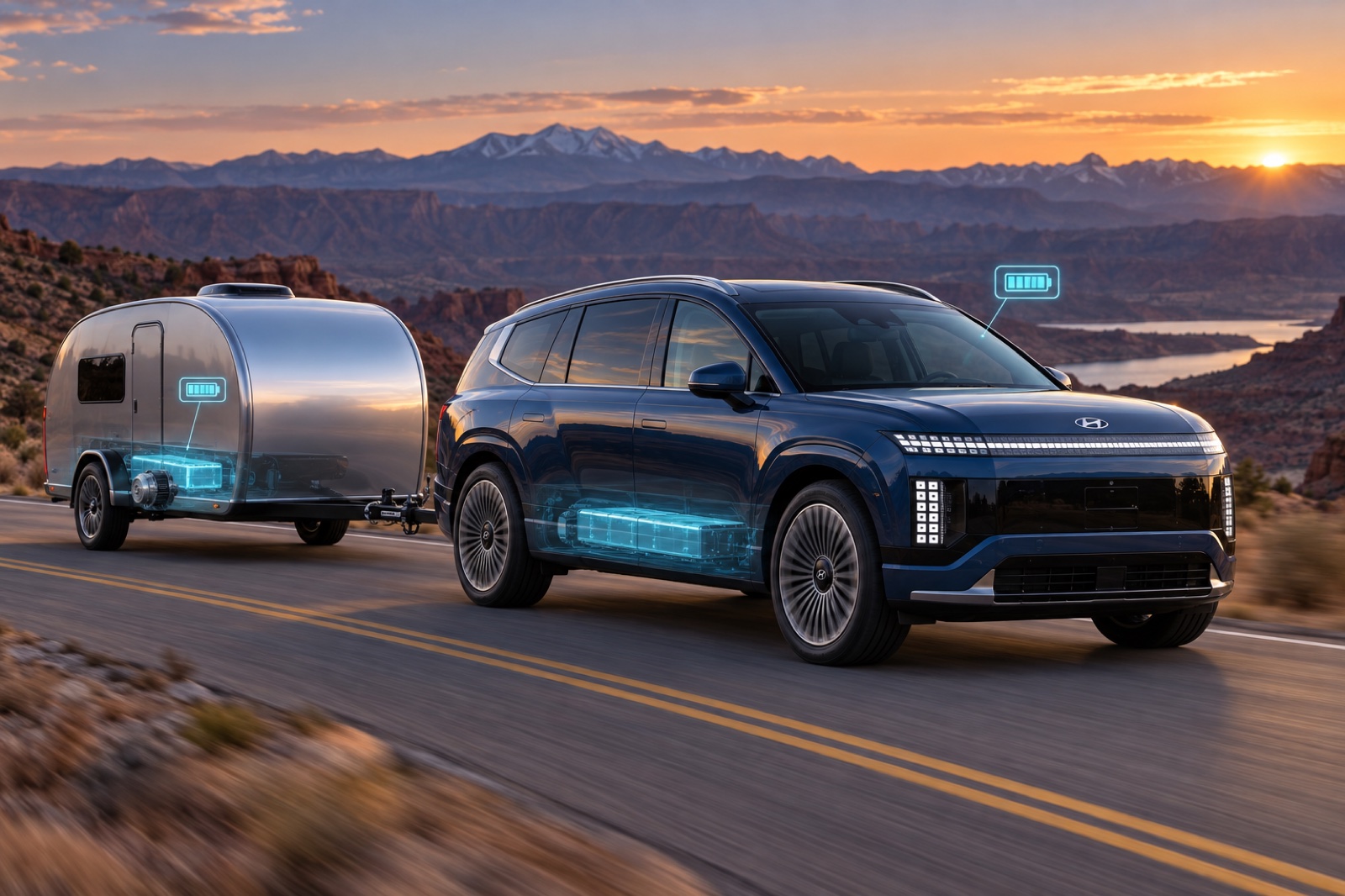
Hyundai and Kia’s latest towing proposal would estimate how far an SUV and a powered camper can travel before either leaves the driveway. That means accounting for two batteries, two sets of driving demands, and the energy the owner wants left on arrival. A camper that helps pull its own weight also needs a plan for when that help runs out.
The system appears in a patent filing discovered by Carmoses and accounts for the energy available in both the tow vehicle and camper. Hyundai and Kia had already described separate vehicle and trailer range estimates, including an arrival reserve, earlier this year. The latest proposal develops the calculation itself, from choosing a towing combination while parked to refining its predicted consumption on the road.
Nothing in the filing names a production model. The SUV towing scenarios make the Hyundai IONIQ 9 a sensible editorial example for these renders, particularly because Hyundai already describes trailer-weight-based range adjustment and up to 5,000 pounds of North American towing capacity. Those existing towing capabilities provide a useful point of comparison for a system that would also account for a camper’s own propulsion.
Two Batteries, One Connected Journey
A powered trailer carries its own energy source and motor to drive its wheels. It remains hitched to the tow vehicle, but its propulsion reduces the pulling effort required from the car. That changes how quickly both consume their available energy.
The proposed system calculates them separately. For each, it estimates energy consumption per mile and divides the energy available for driving by that consumption. The resulting distances are linked by the load passing through the hitch. The camper’s estimate describes its powered contribution under the assumed towing conditions, rather than how far it could travel independently.
A sensor at the coupling can measure the horizontal pulling force and the vertical load imposed by the trailer tongue. Those measurements help describe the work each vehicle is doing. Speed, acceleration, road grade, weight, tire rolling resistance and aerodynamic drag all enter the calculation, along with drivetrain efficiency.
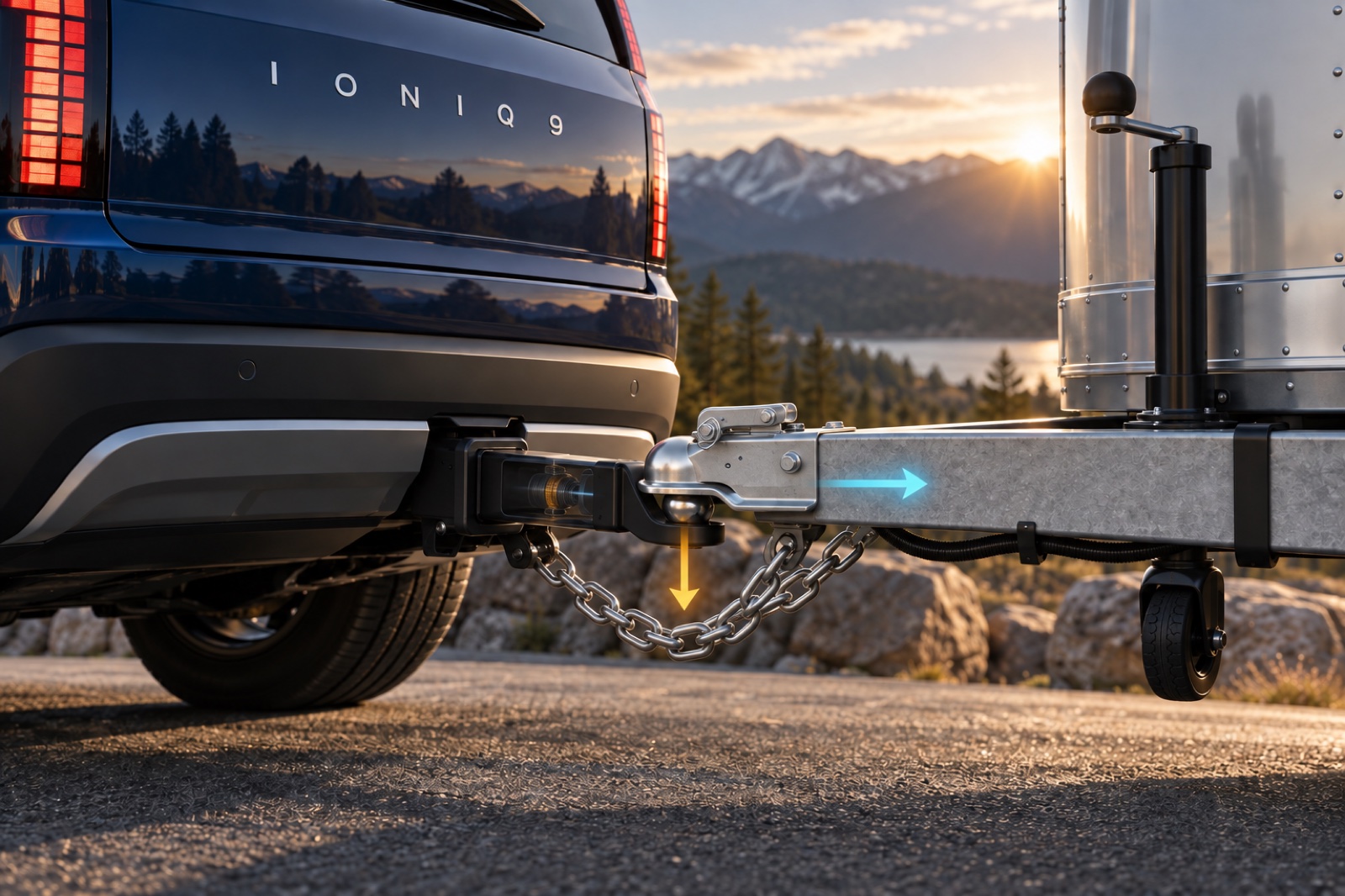
Measurements at different speeds can also help estimate unknown weight and drag. Once underway, the system continuously updates its range predictions. Controllers could use that information to adjust assistance proactively, rather than maintaining a fixed pulling force regardless of which battery has more useful range remaining.
Set Up Before Pulling Away
A driver planning charging stops needs an estimate before setting off, when measurements from the road are not yet available.
The proposed interface lets the owner select a combination of tow vehicle and powered trailer while parked. Stored configurations supply initial assumptions about loading and resistance. Drivers can edit and save a default, and a planned route can help establish the expected driving demands. That provides a starting estimate without first requiring a calibration drive.
Selecting a familiar vehicle shape cannot establish the exact weight of everything packed inside it, and the stationary calculation still depends on stored or estimated values. Subsequent measurements provide a way to refine the prediction.
The energy calculation also looks beyond the charge percentage. Battery health and temperature affect the available supply, while heating or cooling the packs consumes some of it. The tow vehicle’s cabin climate control is another deduction. Only the remaining driving energy goes into the range calculation.
Keep Something For Arrival
An owner could also reduce the trailer charge considered available for propulsion to preserve a chosen amount at the destination, making the adjustment through an app or the camper’s electronics.
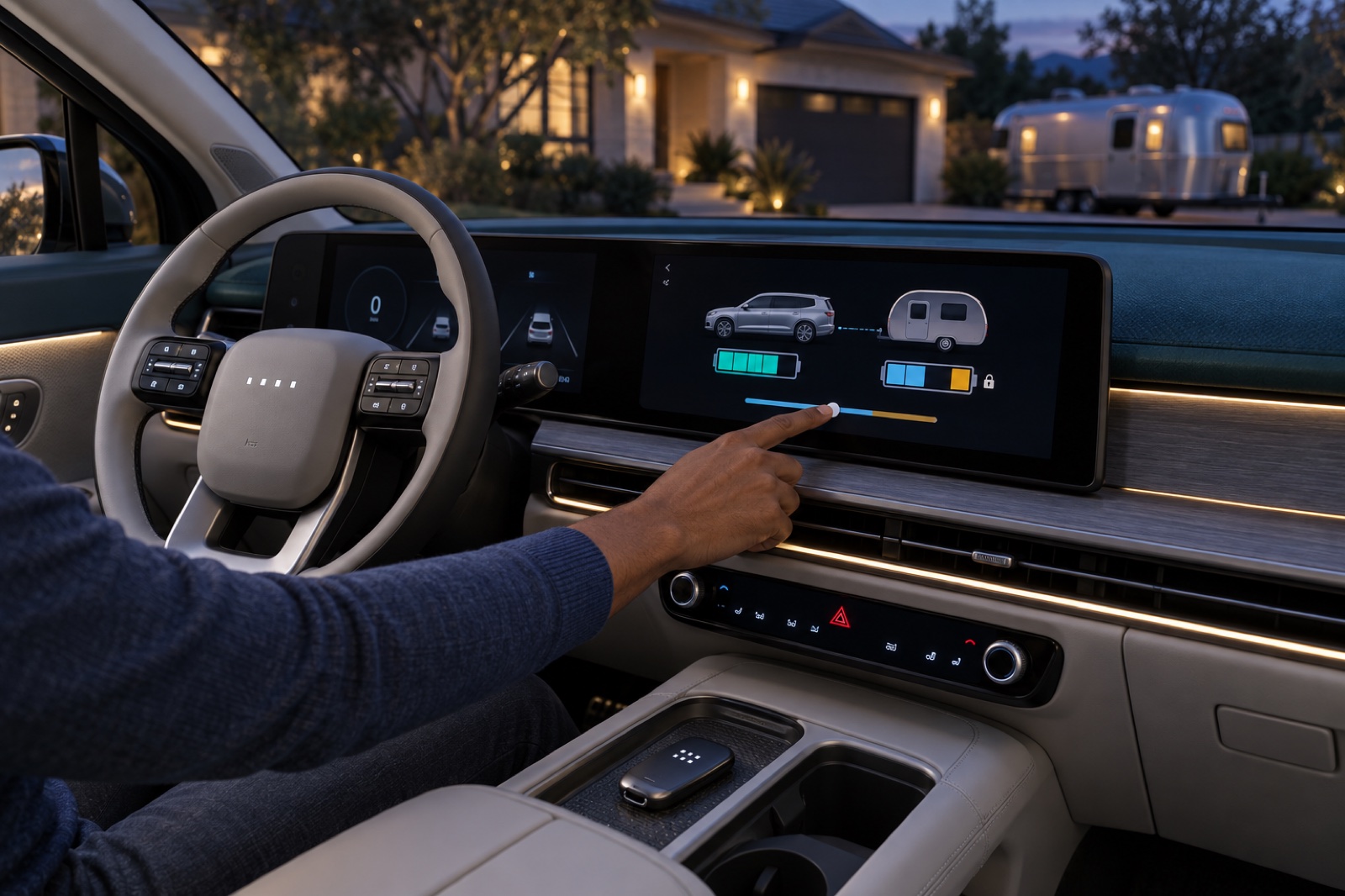
The energy physically present in a battery need not all be available to extend the drive. The proposal does not specify which campsite appliances the reserve would power, or how long it would last, so there is no basis for promising an extra night away from hookups.
Powered campers already have an industry precedent. Lightship previously introduced its L1 with an electric drivetrain and a battery intended to support both towing assistance and onboard living. Hyundai and Kia’s contribution here is a more detailed approach to calculating the energy budget, including gas and hybrid tow vehicles through fuel and engine-efficiency inputs.
There are no measured accuracy results, named trailer partners or production commitments, and a patent does not guarantee production. For owners, the decisive test would be whether the estimate stays dependable as loading, terrain and battery conditions change. This is a worthwhile planning tool on paper, but its value will be earned by the miles it predicts correctly.