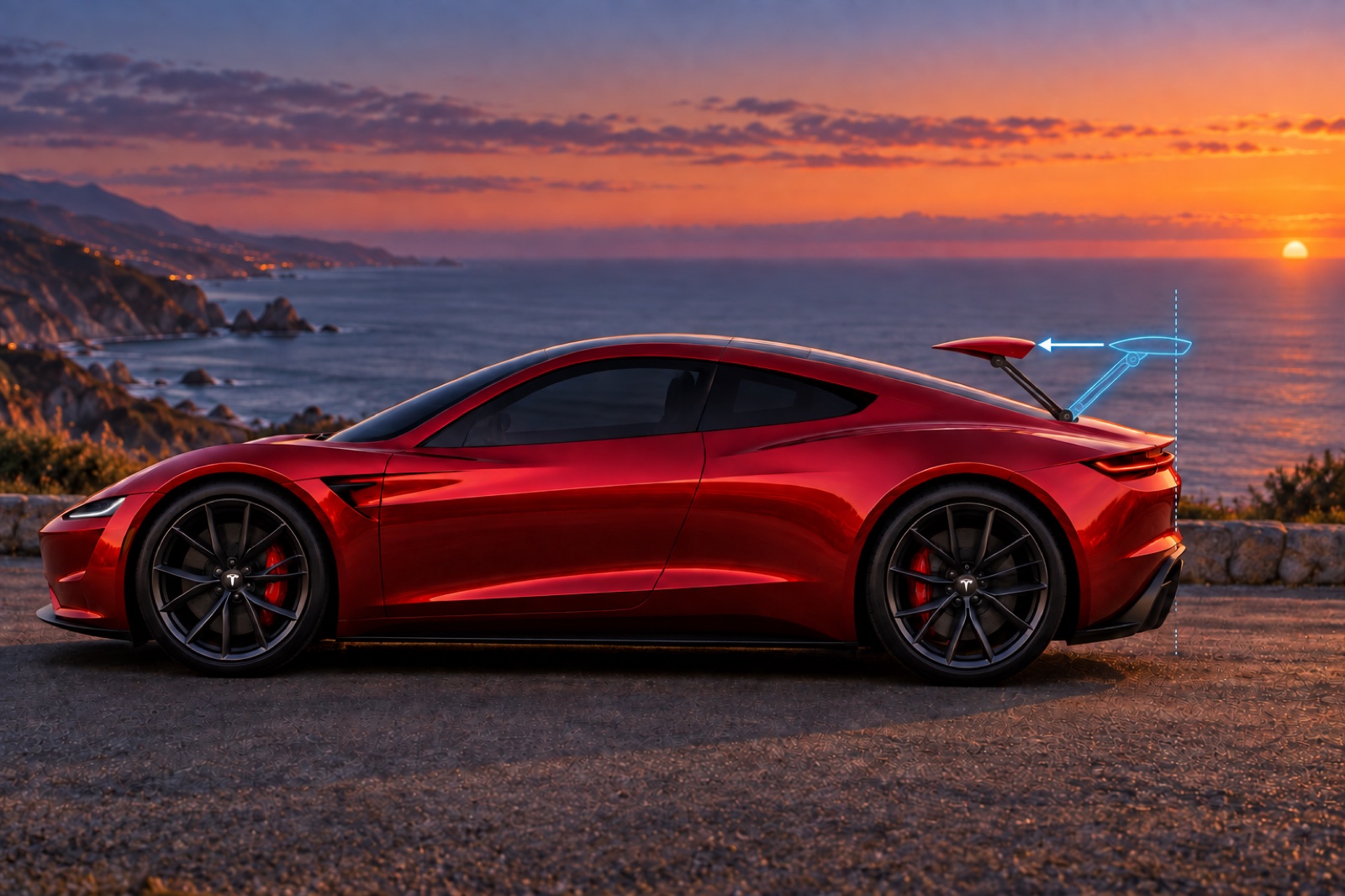
Tesla is proposing a rear wing that can withdraw before a predicted collision, reducing the projection a pedestrian or cyclist could strike, according to a patent filing discovered by Carmoses. Its controller faces a difficult decision, though. Moving that hardware out of someone’s path also changes the aerodynamic forces keeping the car stable.
Tesla was testing active wings on Model S prototypes years ago. The interesting detail here is how a performance device could respond to a hazard it creates for people outside the vehicle, including through a mechanical release that needs no electronic warning.
Nothing in the filing names a production model. The low coupe proportions and track-focused hardware make the Roadster concept a reasonable showcase, which is why it provides the basis for the renders here.
Retraction Has To Preserve Stability
Fully extended, the wing can project beyond the back of the car. The proposed protection system brings its trailing edge forward until it no longer protrudes past the rear body outline. That can mean stopping in an intermediate position instead of completing the whole movement into storage.
Sensors supply information about an approaching object, allowing the controller to estimate collision probability and time remaining before contact. Above a chosen risk threshold, it can begin withdrawing the assembly. Separate contact detection can trigger a response once an impact starts.
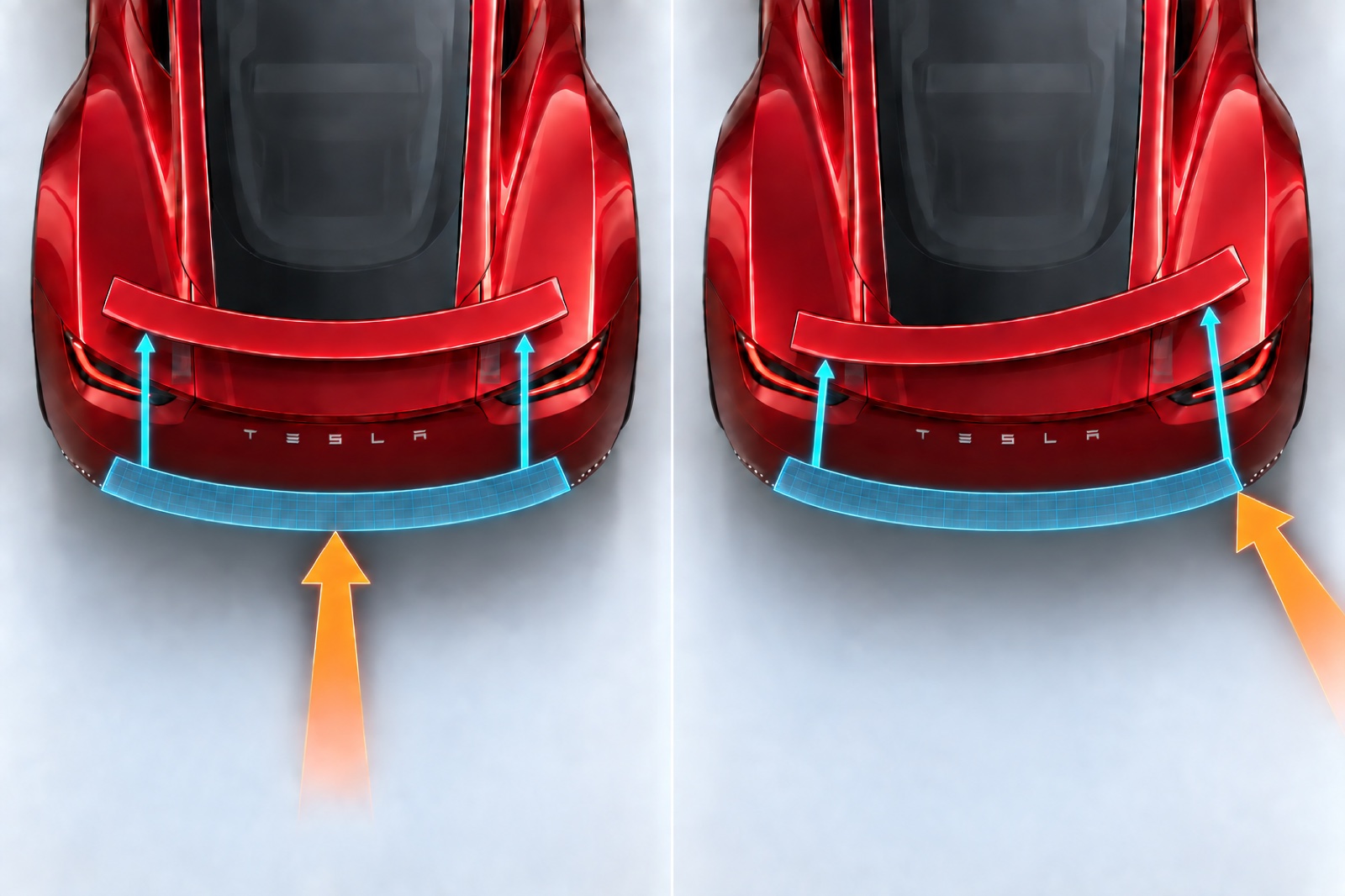
The path also depends on where the hit occurs. A central rear impact can prompt straight forward retraction. For a corner impact, the assembly can move forward while changing its orientation, reducing the exposed portion on the struck side. The wing moves as a unit.
Simply retracting as soon as anything approaches would ignore what the driver is doing. Downforce is the aerodynamic load pressing the tires into the road, and changing it abruptly affects the car’s balance. Tesla’s controller therefore considers speed, steering, braking and cornering forces alongside the collision threat.
Partial withdrawal or a position adjustment could address the approaching hazard while accounting for the grip still needed. That makes the control strategy more demanding than a switch triggered by proximity alone. It must judge both how soon an impact might happen and what moving the wing would do to the vehicle.
A Release That Needs No Sensor
Tesla also describes a passive mechanical option. A calibrated latch holds the assembly in place under normal aerodynamic loads, then releases when a rear impact exceeds a predetermined force. Guides constrain the retreat, and damping elements control its movement.
That gives the mechanism a way to yield without waiting for electronic detection. It is an impact response, so it cannot provide the advance warning offered by predictive control. Following an event, the assembly can stay retracted until manually reset.
The missing numbers matter. Tesla supplies no exact emergency-retraction time, numerical release threshold or injury-test results demonstrating the proposed protection. Those omissions prevent a judgment about how much difference this would make in a real collision.
The Track Hardware Still Matters
The wing has two aerodynamic surfaces. Its main element blends into the rear deck when stowed, while a smaller strip called a leading-edge slat hides beneath the body panel. Deployment carries the assembly upward and rearward, exposing a narrow airflow gap between the two pieces.
The slat helps turn the airflow and allows the main surface to operate at steeper angles. Both elements can rotate together. Jointed supports raise the assembly, while separate actuators concealed inside the support arms change its angle.
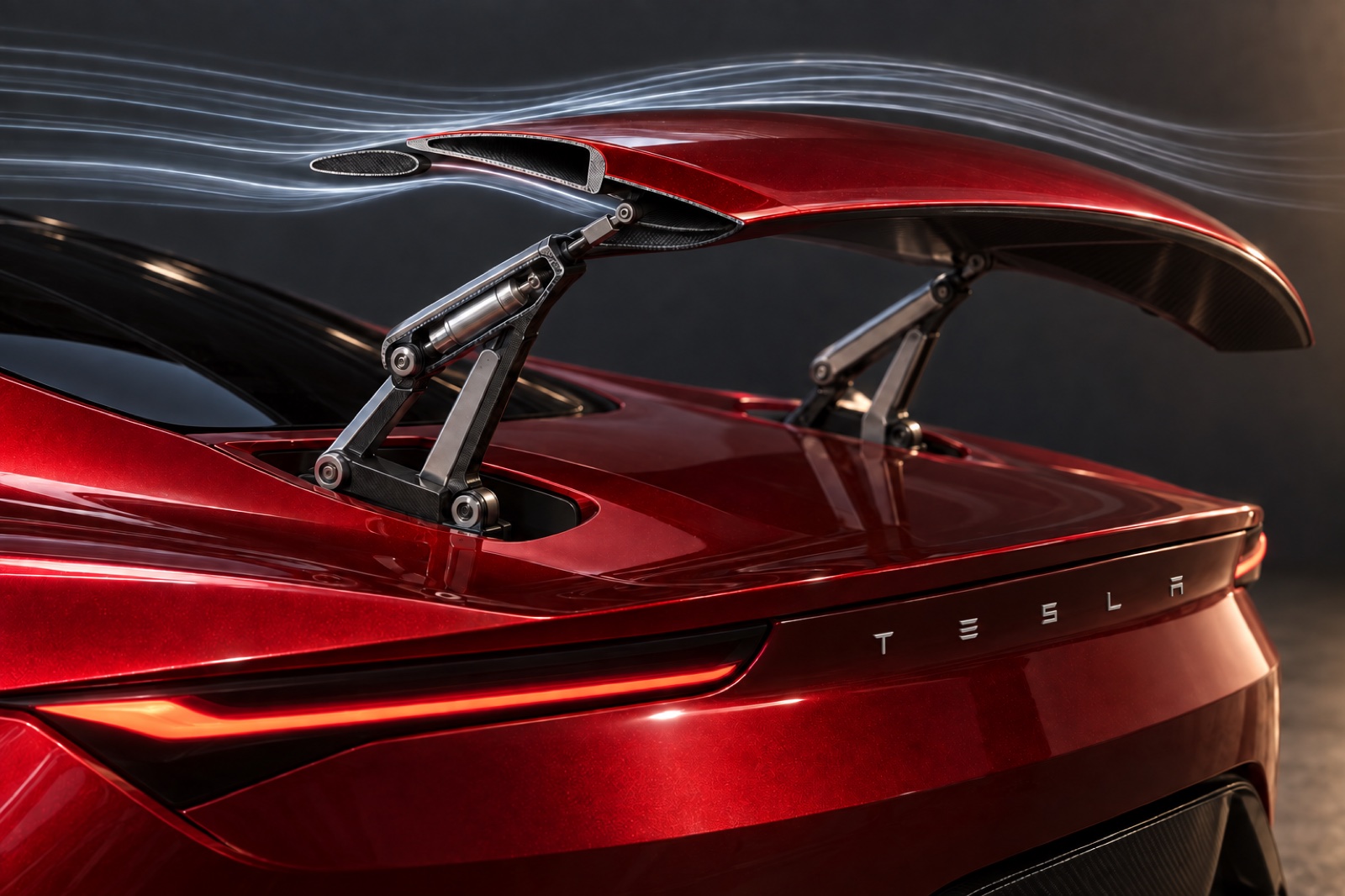
As the driver accelerates along a straight, the controller can select a drag-reduction position. Braking or fast cornering can call for more downforce. Location data can also trigger deployment on arrival at a racetrack, without requiring the driver to command every movement.
Tesla describes deployment in under three seconds and angle adjustment in less than a quarter-second. That faster figure concerns rotation during aerodynamic control, not a demonstrated collision-retraction time. The drive can also resist aerodynamic loads at a selected position without continuously powering its actuator.
Moving aero already serves purposes beyond outright speed. Early Model X vehicles used a powered spoiler, while Porsche has used the 911 Turbo S’s adjustable aerodynamics to shift balance rearward in Wet mode and increase drag during hard braking at high speed. Tesla’s proposal extends that discussion to the people who might strike the hardware itself.
A patent does not guarantee production. This is a worthwhile direction for active aero because it addresses an exposed component’s consequences alongside its performance benefits. The decisive test is whether it can clear that projection quickly enough without destabilizing the car, and Tesla has yet to provide the evidence needed to establish either result.