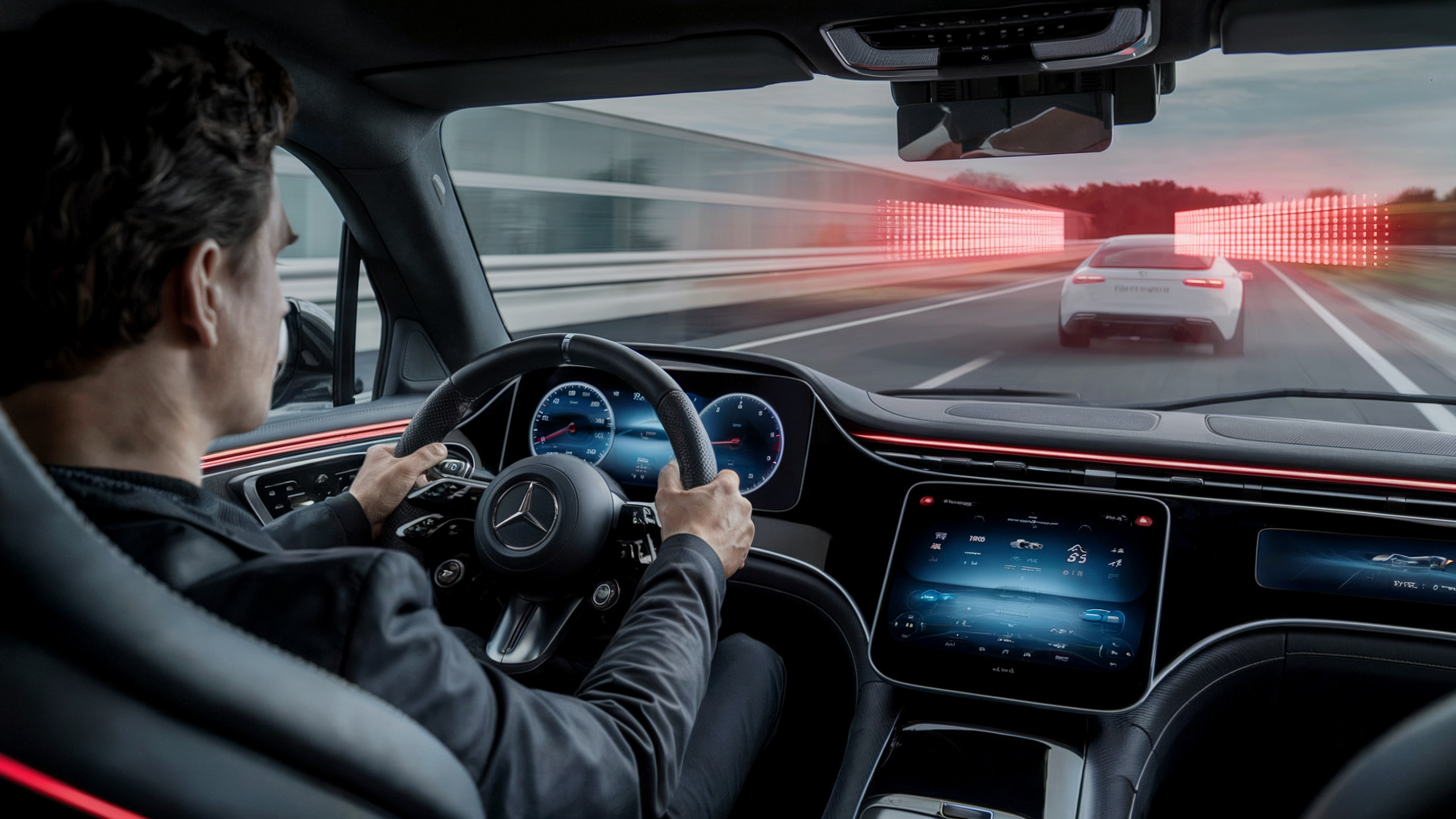
Mercedes-Benz has again demonstrated its ability to foretell what next-generation safety technology could look like with a new patent filed at the German Patent and Trademark Office. Therein, the German automaker discusses using virtual reality to project an image of the illuminated brake lights of a car further ahead on the road, noting that it would be particularly useful in scenarios when those taillights are obscured.
How It Works
The augmented reality aspect of the invention could apply to anything from a traditional head-up display to a headset accessory, like glasses. As for how the following car would detect the brake lights of a car ahead when they would otherwise be invisible, such as a drive on a dark, twisting mountain road, or in the rain or fog, this requires a future society in which inter-connected cars are commonplace; the patent specifically notes establishing a connection with the leading vehicle. Using sensor data from the leading car, the following car could receive advance warning of a braking event up ahead.
Why It Matters
The safety implications here are clear. If such technology could work reliably and repeatedly, not only could it reduce the risk of incident through driver error, it could also potentially act as one of many failsafes or confirmation sensors for a fully autonomous self-driving technology suite. It could also help to reduce traffic in low-visibility conditions when cars tend to space out. While cars would still have to slow down, they would be able to follow each other much more closely, like cars in a railroad train.