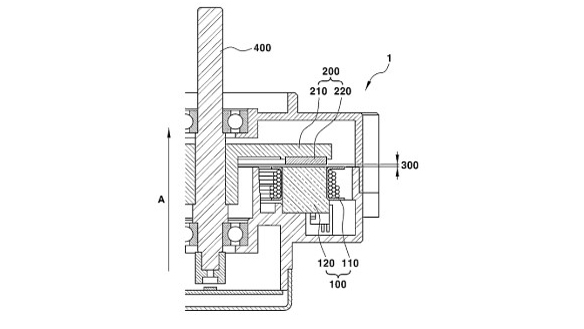

Hyundai is targeting greater electric motor efficiency with a newly patented rotor design for axial-flux motors. Filed with the United States Patent and Trademark Office, Hyundai’s innovation uses an anisotropic material in part of the stator core to reduce iron loss, a key contributor to inefficiency.
Recent electric motor development has often focused on improving stator design. Porsche’s grooved stator patent aims to improve cooling and possibly eliminate the cooling pump, while GM’s conductor arrangement enhances performance and efficiency. Hyundai’s new approach, however, focuses on the rotor itself to deliver further efficiency gains.

Understanding Iron Loss and Material Choice
Isotropic materials have the same properties in all directions and include substances such as metals and glass. Metals like iron are commonly used in the construction of stators in electric motors, but this leads to iron losses. These losses occur because of the continuous magnetization and demagnetization of the iron core as current flows through it.
Anisotropic materials, by contrast, display different properties depending on the direction and can be optimized to dramatically reduce iron loss.

Rethinking Stator Construction
Hyundai says that constructing the parts of the stator core where the magnetic flux is at a smaller angle to the motor’s axial direction from an anisotropic material has the potential to reduce iron loss by 23% at the same torque level in both the straight and curved magnetic flux sections of the stator core. Other parts of the stator core can still be made of iron where it has little or no impact on motor efficiency.
Hyundai says constructing the stator from the correct mix of materials can optimally reduce iron loss by as much as 179% in the best-case scenario.
Key Benefits of Hyundai’s Approach
Hyundai’s patent is notable for its combination of isotropic and anisotropic materials within the stator core, offering several potential advantages:
- Improved motor efficiency
- Greater vehicle range due to lower energy consumption
- Smaller battery packs required for the same range
- Increased motor performance
Hyundai’s methodology represents a promising advancement in axial-flux motor design. Strategic material selection could offer substantial efficiency gains for next-generation electric vehicles.