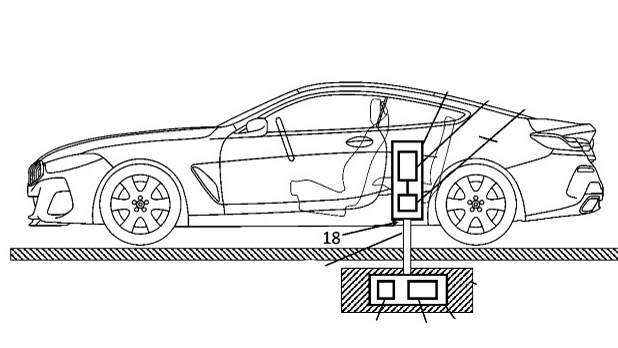
BMW has filed a patent with the European Patent Office that outlines a hybrid system that adds a supercapacitor to the existing hybrid battery, enabling the system to charge very quickly, making it ideal for motorsport applications where rapid charging is paramount. This patent is another step toward bringing the expensive supercapacitor hybrid tech found in the Lamborghini Sián FKP 37 to the mainstream.
Advantages Of Supercapacitors Compared To Batteries
Supercapacitors have a far lower voltage limit and much higher capacitance than solid-state capacitors. They can be seen as a halfway house between solid-state capacitors and the typical rechargeable batteries used in electric vehicles (EVs). Compared to rechargeable batteries, supercapacitors have various advantages:
- Store more energy per unit of volume or mass
- Are significantly lighter for the same capacity
- Charge and discharge at much higher rates
- Withstand many more charge cycles without degradation
BMW’s Hybrid Supercapacitor System Promises 1-Minute Charging
Whereas the Lamborghini hypecar exclusively uses supercapacitors, the BMW patent adds batteries to the system. Specifically tailored for motorsport, BMW says that its hybrid system can be fully charged in as little as one minute with a high-power charging system, combining high energy density with very fast charging capability. The system can also harvest energy via brake regeneration to put back into the system.
BMW says that the system overcomes one of the main complaints against EVs, namely slow charging compared to filling up a gas car. It says the system can also be adapted and optimized for other uses, such as in buses and trains. We assume that the fast-charging capacitor will drain its energy into the rechargeable battery at a rate the battery can accept, but will retain a charge that can quickly be dumped back into the drive system for the vehicle’s power demands.
A Practical Bridge to the Future of EV Power
While the EV industry continues to search for the next leap in energy storage, balancing performance, cost, and scalability, supercapacitors remain promising but pricey, and solid-state batteries are still not commercially viable at scale. BMW’s new patent could be a clever interim solution, combining the quick-charging performance of supercapacitors with the practicality and availability of current hybrid systems to deliver real-world gains without waiting for the perfect battery.