
Mazda has applied for the trademark of three new vehicle names, extending known nameplates for use as EVs. Filed with the EUIPO, the names trademarked are ‘Mazda 2e’, ‘Mazda 3e’, and ‘CX-5e’, which leave little to the imagination as to what they might be.
Mazda has already used the lowercase ‘e’ suffix before now, with the Mazda 6e revealed in January this year as an electric take on the Mazda 6 sedan. These new names, then, confirm that Mazda is, at the very least, considering electric versions of the 2, 3, and CX-5.
New Generations Of Each Model Incoming
With no Mazda 6 in production for a while before that, the 6e is a new generation model with no combustion counterpart. But the same can’t be said of the 2, 3, and CX-5. All three nameplates are still in production and are relatively popular models for Mazda, especially the CX-5, which remains a top seller nearly a decade after the current generation’s introduction. We know a new generation of CX-5 is due to launch this year, with Mazda confirming it will have a hybrid powertrain, at least as an option.
The Mazda 2 is even older than the CX-5, with the third generation launching in 2014. While two facelifts might have kept it visually fresh, it’s begging for an overhaul. The Mazda 3, meanwhile, is relatively young. The current generation has been around since 2019, which makes it young compared to the other two but nearing the end of a typical life cycle for a modern motor vehicle.
As such, it’s fair to assume that these new ‘e’ names will be used for the next generation of each of these vehicles as Mazda aims to make up for its slow transition to electrification.
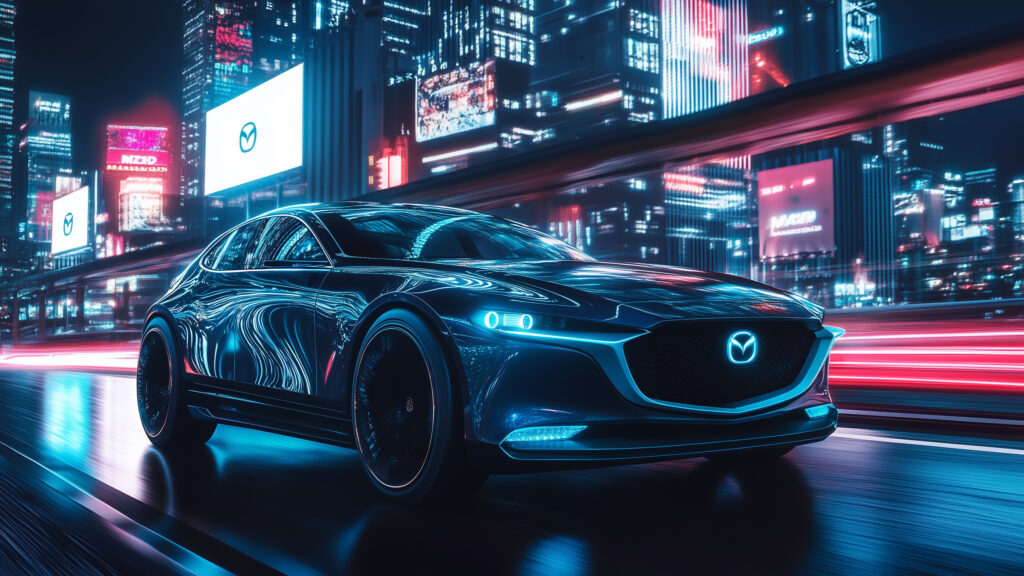
Mazda Lagging Behind On EV Development
Mazda, like many Japanese car makers, has lagged behind on EV development. While most European and American manufacturers have multiple EVs in their lineup and several more in development, Mazda has so far produced one EV, and it wasn’t a great one.
The MX-30 struggled with sub-par range (100 miles based on EPA testing), leading to a range-extender version being launched in Europe using a small rotary generator. This variant never reached the US, while the EV was ultimately discontinued.
Mazda has acknowledged it’s fallen behind the curve, but while it has pledged to achieve greater levels of electrification across its lineup – hybrids included – it hasn’t put all its eggs in one basket. Mazda is still developing new combustion engines, notably the Skyactiv-Z engine family and a new rotary family. Additionally, hybrids will make up a large slice of the pie for future models.
While the 2e, 3e, and CX-5e are likely to be battery-electric models built with new-generation hardware, we can’t rule out Mazda using rotary engines as range extenders here, too, making them viable for a multitude of markets where pure battery-electric vehicles are unfeasible.
Whatever the case, we shouldn’t have to wait too long to find out.