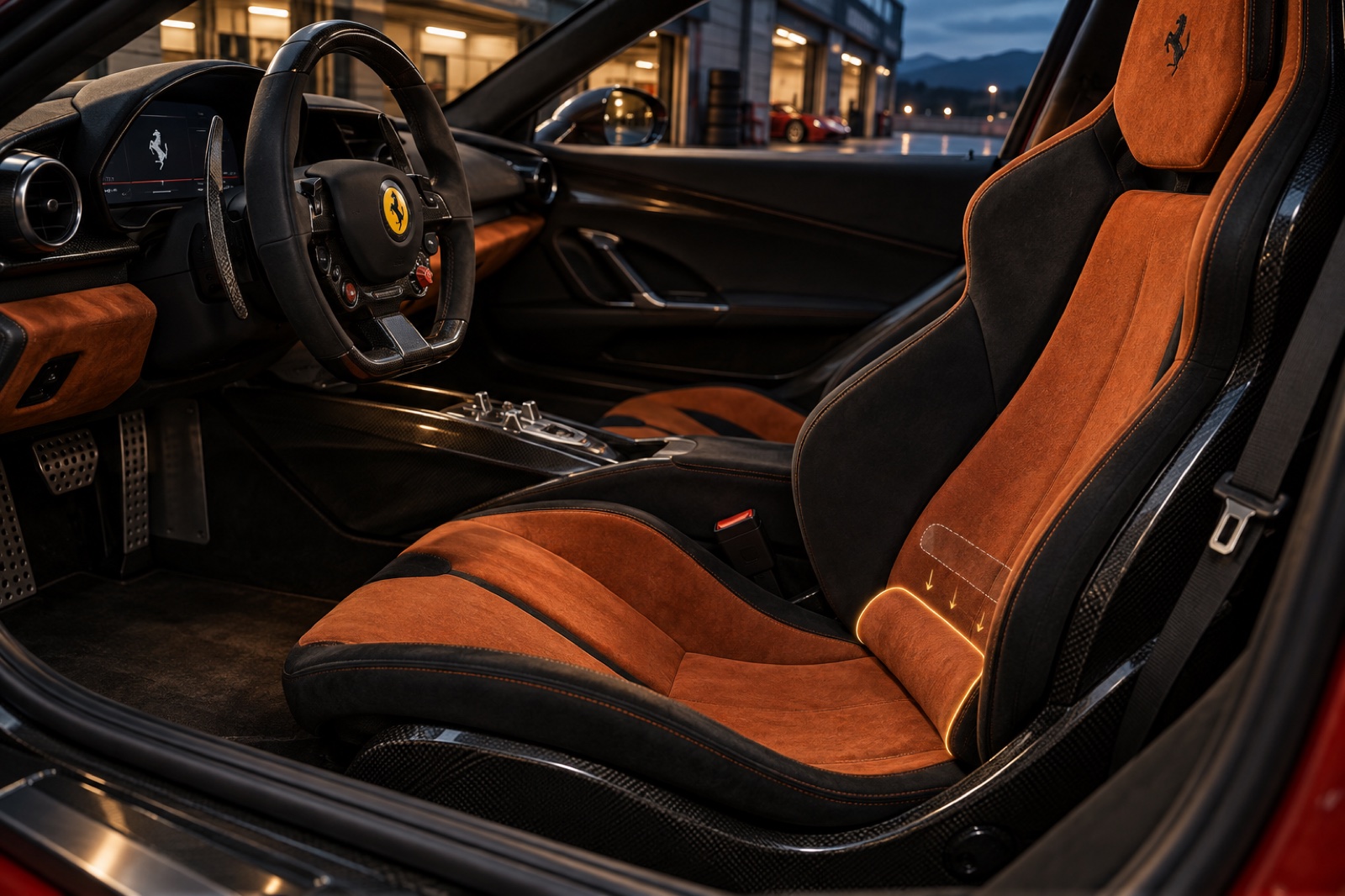
Settle into a low-slung Ferrari, get the backrest just right, then fill the little gap beneath your lower back. Ferrari wants to make that last step possible with a support that slides into place, or one that inflates like a miniature air mattress. When it is time to adjust the seat again, the support gets out of the way.
That is the idea behind a patent filing discovered by Carmoses: a retractable bridge between the seat cushion and backrest, designed to make a lightweight sports seat more comfortable over a long stint. It tackles an awkward compromise. The seat needs clearance to recline; your back would prefer an uninterrupted place to rest.
There is something pleasingly Ferrari about solving this with a tiny moving part. Keep the sculpted shell, keep the snug fit, and put the extra support exactly where it is needed.


Mind The Gap, Maranello
The troublesome space sits at the very bottom of the backrest, above the rear edge of the cushion. In Ferrari’s proposed seat, that separation gives the backrest room to pivot. Filling it permanently would put an obstacle in the mechanism’s path.
Ferrari’s answer is to make the missing piece retractable. In the sliding version, a compact insert lives inside a recess at the bottom of the backrest. Deploy it and it travels toward the cushion, filling the junction. A thin upholstered face makes the added section feel like a continuation of the seat, rather than a bare mechanical plug.
A hand-operated lever beside the seat can move the insert along a guide. An electric motor is another option. Ferrari also allows the arrangement to work from the other direction, with the insert emerging from the cushion toward the backrest.
The aim is to spread pressure more evenly along the occupant’s back. Ferrari singles out the reclined posture of a high-performance sports car, where the lower back takes more of the load. That makes this a particularly relevant little fix for a seat built around thin padding and a rigid structure.
The Air Mattress Gets A Promotion
The inflatable version does the same job with an airtight bag. An electric motor drives a pump, which pushes air into the bag until it expands into the gap. To withdraw it, the pump sucks the air back out, shrinking the filler into its stored position.

Think of a small upholstered bridge that can pack itself away. Instead of moving a block that always keeps the same dimensions, this version changes the filler’s size. The useful trick is its location: right at the joint between the two main parts of the seat, supporting a spot that needs to be empty during adjustment.
For the driver, the sequence is straightforward. Retract the filler, set the backrest angle, then deploy the filler again. Ferrari puts the recline control on one side of the seat and the filler control on the other. Once comfortable, you leave the gap closed for normal driving.
Recline First, Bridge Second
Ferrari has also thought about what happens when someone reaches for the recline control with that bridge still in place. One solution links deployment to a mechanical lock that prevents the backrest from turning. That protects the insert from being crushed between the moving parts.

The alternative lets the support give way. Its mechanism holds the filler with a deliberately limited force, allowing the moving backrest to push it back into storage without damage. Retracting it first remains the easier way to adjust the seat, because forcing it back takes more effort. Those details matter for a seat position that gets set once and rarely touched again.
Less Padding, More Thought
Ferrari has already explored flexible bellows that maintain continuity between the side supports of a cushion and backrest as the seat reclines. This new approach brings a deployable support to the central gap beneath the occupant’s back.
The 296 Speciale provides an easy setting for the idea, with its carbon-fibre and Alcantara cabin. Its Piloti Ferrari treatment goes further with thermoformed black Alcantara racing seats and inserts made from the fireproof fabric used for Ferrari’s official drivers’ suits. Picture a discreet comfort adjustment tucked into that sort of pared-back cockpit.
Porsche has pursued the same broader comfort challenge through its 3D-printed seat cushioning, offered in three firmness grades when it went on sale in 2021. Even a serious bucket seat benefits from some attention to the human occupying it.
Carmakers patent far more than they build, but this is an appealingly focused fix for a place the driver feels every mile.