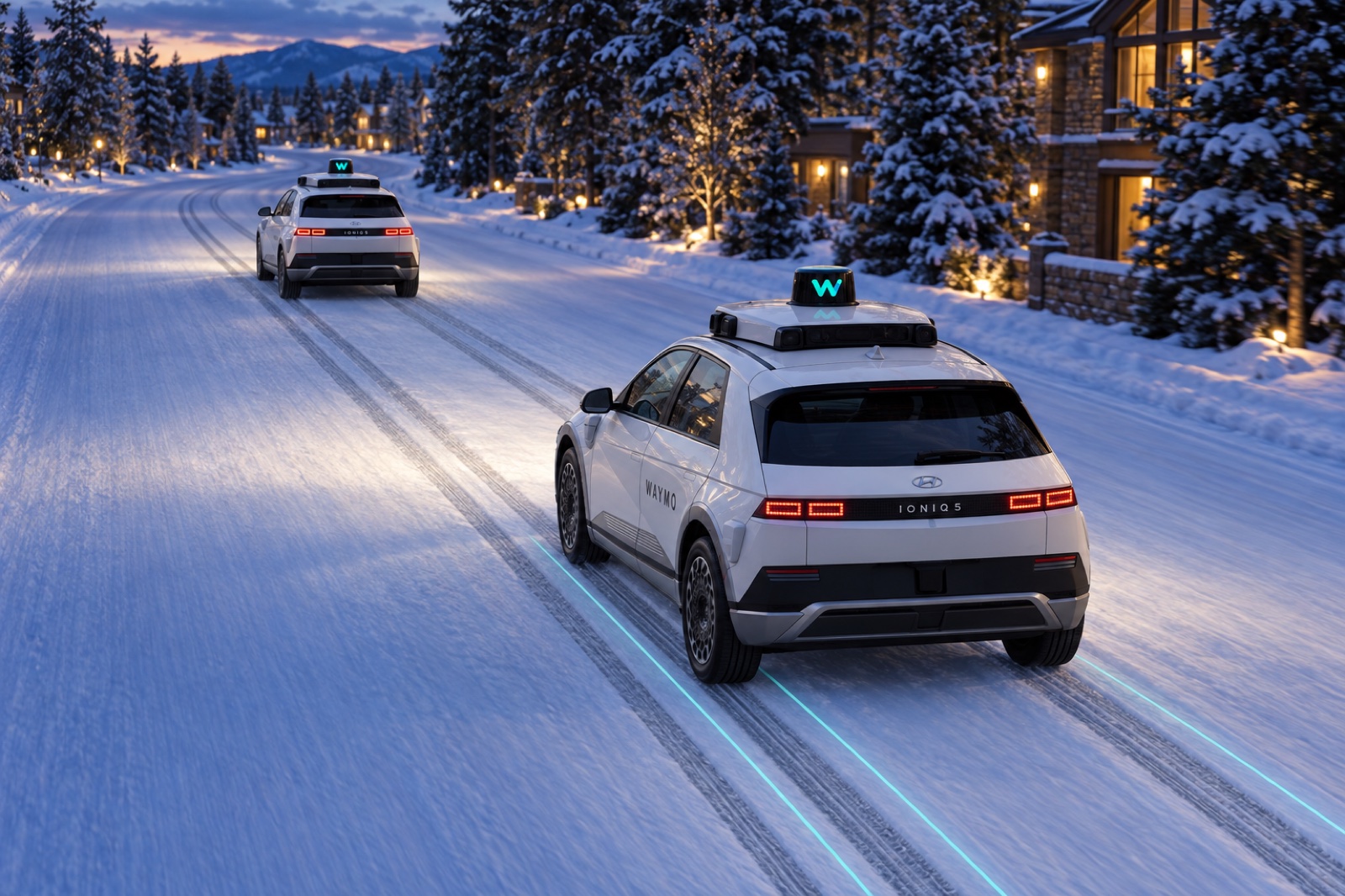
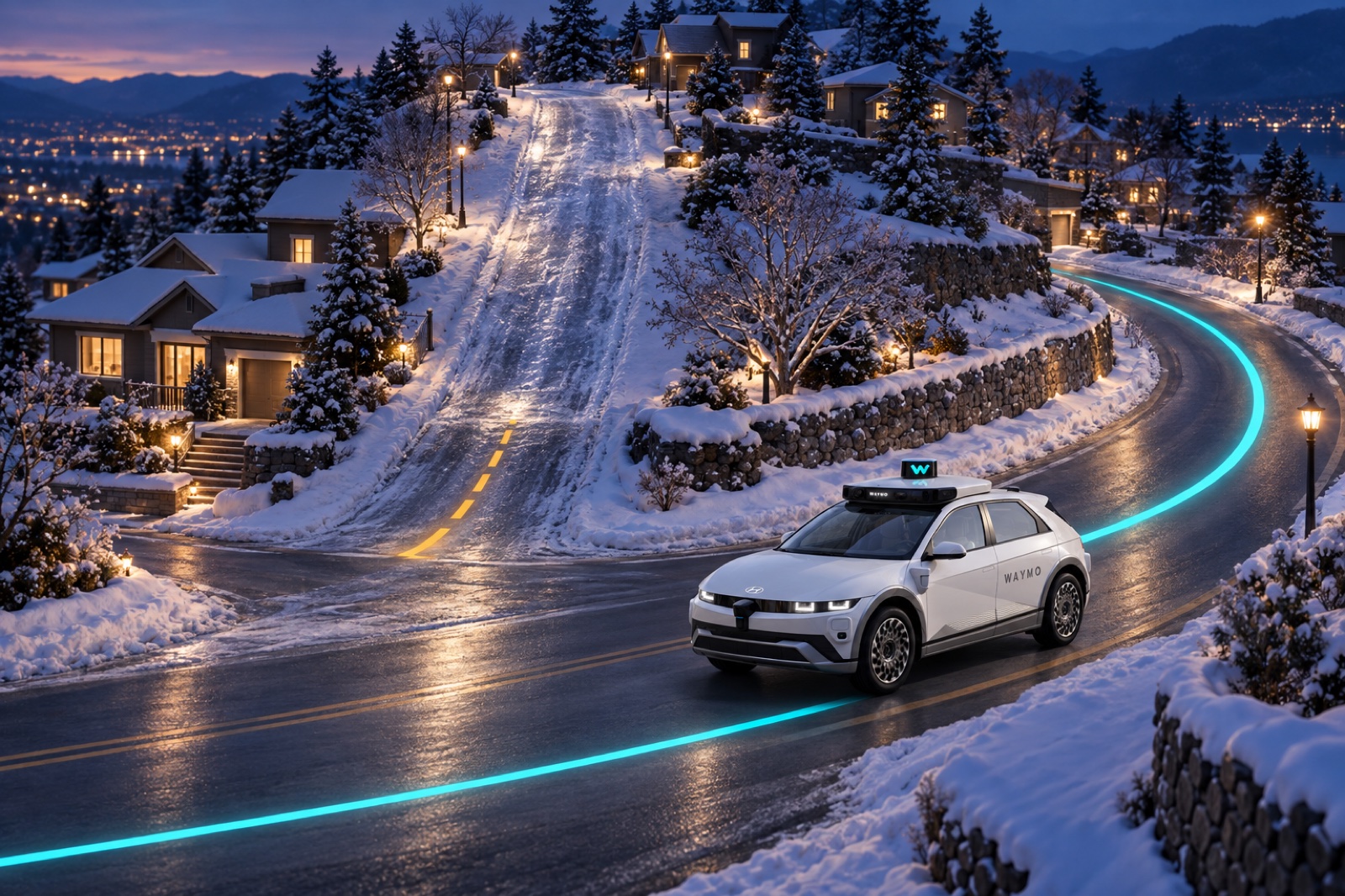
Waymo has described a winter-driving technique that deliberately puts a following car’s tires beside the tracks left by the vehicle ahead. Each of its robotaxis could then measure how it responds to the snowy surface, compare the results and share information about where grip is better. The next vehicle would have more to work with than a visible pair of ruts.
A patent filing discovered by Carmoses describes a winter-driving approach focused on identifying and following the path with the highest friction. Waymo first made the offset-track technique public six years ago. The engineering question remains relevant because recognizing snow does not, by itself, establish how much grip a tire will find.
Waymo already says its winter-driving system distinguishes snow, slush, ice and normal pavement, adjusts acceleration and braking for reduced traction, and shares weather observations across its fleet. Those public descriptions do not establish that this particular track-comparison technique is in service.
A Small Shift Within The Lane
The process begins with a lead vehicle driving through snow and leaving tracks. A following car detects those marks using cameras or lidar, the laser-based sensors that measure the surrounding environment. It can then steer slightly sideways, placing its wheels away from the existing ruts while remaining within the lane.
The useful information comes from comparing what the vehicle expected to do with what it actually did. Wheel rotation, measured speed, position and changes in direction can reveal a mismatch. A car that travels differently from its planned movement may be losing traction, giving its computer a reason to revise the path or braking strategy.
Driving through the material could also help estimate its depth and distinguish powdery, slushy or compacted snow. Camera and lidar readings can supplement that assessment. No separate braking or acceleration test is required for every pass.
Several vehicles could contribute observations from different lateral positions. The results could update a shared map, feed another car’s route planner or generate a warning for vehicles nearby. There is no fixed assumption that the existing tracks, or the untouched snow beside them, will always be preferable. Comparing their effects is the point.
No model is named in the filing. The passenger-vehicle application and Waymo’s announced Hyundai partnership make the Ioniq 5 a suitable stand-in for these renders. Waymo said earlier this year that it had begun autonomous driving with that platform while a specialist was present, but use of this particular technique on the Hyundai remains unconfirmed.
Finding Grip Can Involve Applying The Brakes
A separate, optional test is more direct. On a straight or otherwise constant path, the car could increase braking until feedback from the anti-lock braking system indicates that its wheels are starting to lose traction. Illustrative brake applications last between 0.1 and 2 seconds, although the proposed range is not a fixed operating limit.
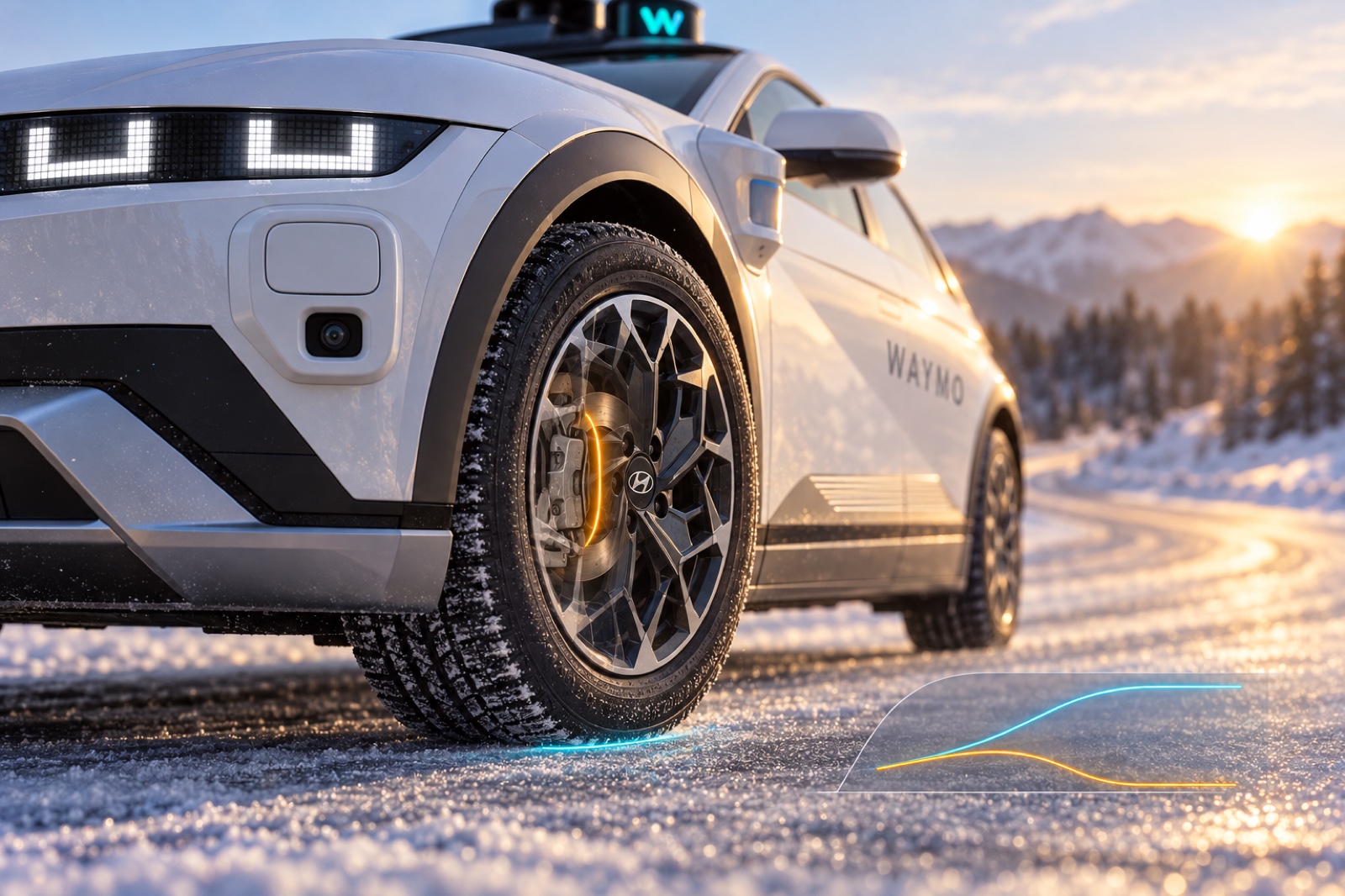
That maneuver comes with conditions. The system can require clearance from surrounding traffic, including sufficient separation from a vehicle behind. Another active-testing example allows restrictions such as having no passengers aboard and determining that the likelihood of losing traction or steering control is very low.
Those are proposed safeguards, not evidence that a passenger-carrying fleet is conducting these tests. Ordinary driving can also supply information, including slowing for a stop sign or negotiating a turn. The robotaxi does not have to provoke wheel slip every time it needs a better understanding of the road.
The filing supplies no measured improvement in stopping distance or success rate for choosing the better track. Nor does it establish how reliably a grip estimate transfers between vehicles using different tires.
The Route Can Change With The Surface
The consequences extend beyond positioning the car within a lane. The planner could account for additional snow expected during a trip, distinguish plowed lanes from uncleared ones and use earlier weather information to assess whether fresh snowfall conceals ice.
It could avoid a hill, choose another freeway exit or change the drop-off point. For a rider, that last possibility matters as much as a smoother braking maneuver. A change in road conditions could alter where the trip ends.
The shared information need not remain unchallenged. Remote assistance could ask another vehicle to check an earlier traction report, allowing the fleet to learn whether a stretch has improved or deteriorated. Waymo’s earlier public weather research already described combining vehicle observations into local weather maps, so sharing observations has an established place in its approach.
A patent does not guarantee production. The strongest part of this proposal is the ability to recheck a road and change the driving plan as conditions evolve. That is a useful basis for winter robotaxis, but its value depends on demonstrating that the grip comparison is reliable enough to justify the maneuver used to obtain it.