
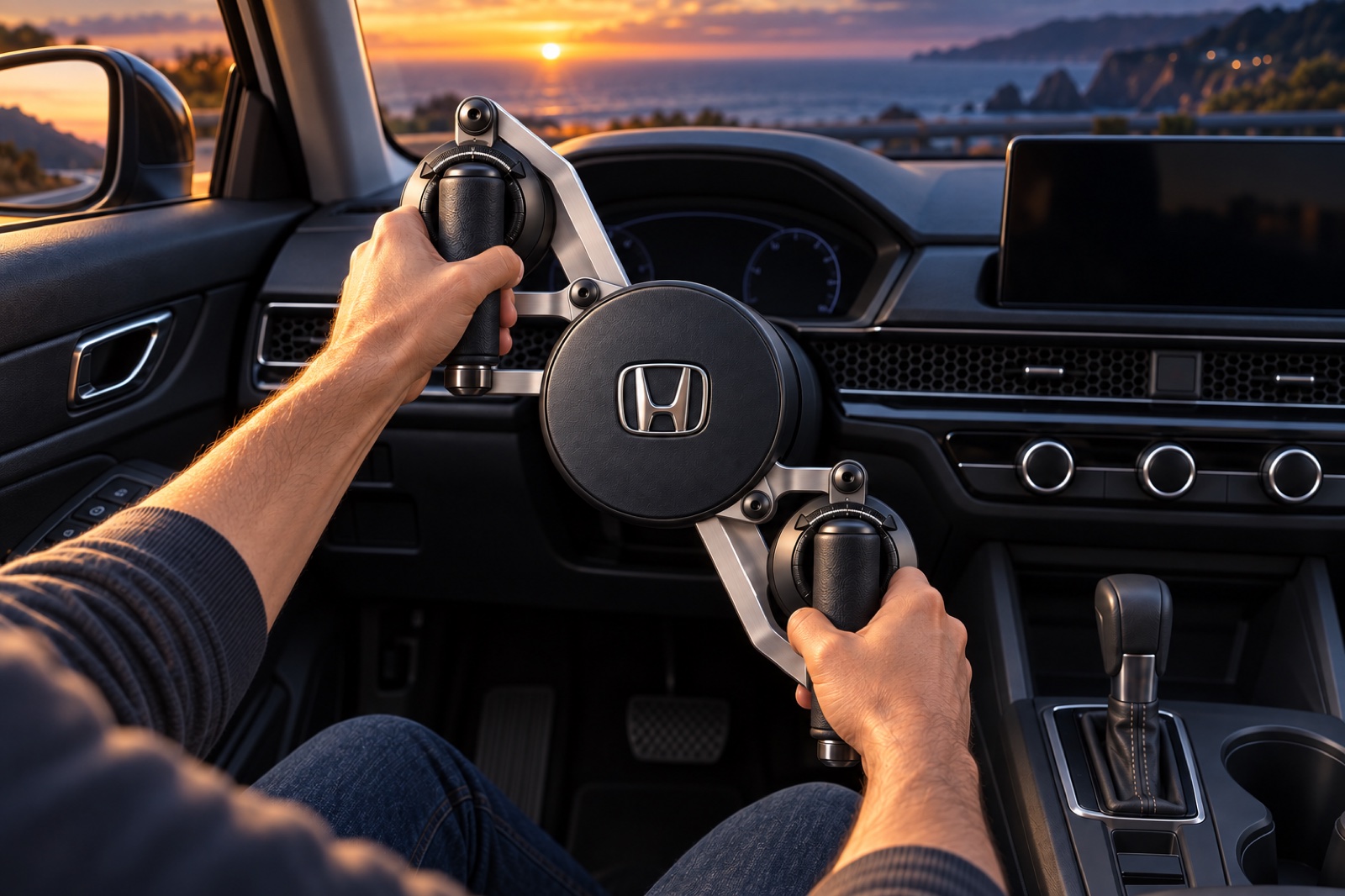
Honda has proposed a steering wheel that changes shape to keep acceleration and braking within fingertip reach through a tight turn, according to a patent filing discovered by Carmoses. Its handles travel up and down while staying upright, allowing the driver to keep holding them as the surrounding structure pivots.
That movement addresses a specific difficulty with hand-operated driving. When the controls for speed sit beside the driver’s fingers, changing grip during a large steering input becomes awkward. Honda’s stated aim is to reduce strain on wrists, elbows and shoulders while preventing steering movements from interfering with acceleration or braking.
Nothing in the filing names a production model. The images place the mechanism in a Civic Sport Touring Hybrid as an editorial choice, because that car already has steering-wheel paddles for adjusting regenerative deceleration. Those existing selectors provide a familiar comparison, although they do not perform the proposed system’s combined accelerator-and-brake function.
The Handles Move Without Tilting
Straight ahead, the assembly looks like an angular frame with a vertical handle at each side. Separate upper and lower arms connect both grip bases to a fixed central mounting plate. Six pivot joints allow those arms to swing while keeping the handles parallel to the center support.
Turn right, and the left grip rises and moves inward while the right drops and moves inward. Both stay upright. At an 80-degree right steering input, the assembly becomes tall and narrow, with one hand nearly above the center and the other nearly below it. That measurement describes the driver’s input, not the angle of the front tires.
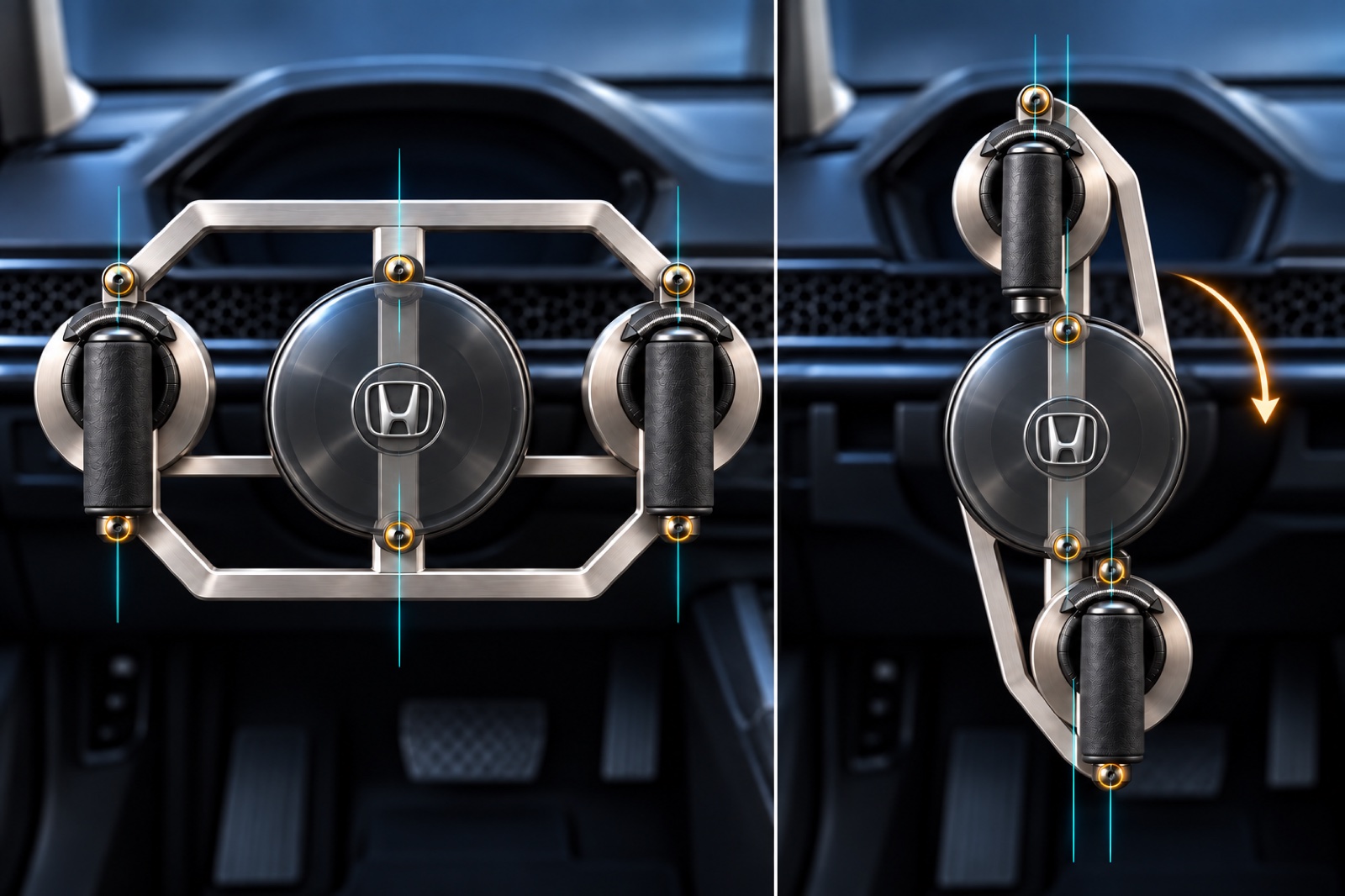
The driver’s arms still move substantially. What stays consistent is the orientation of each handle and the nearby speed control, so the fingers do not have to follow a grip that tips sideways as the steering turns.
Commands reach the car electrically. Moving the linkage rotates an output shaft whose angle becomes the steering signal. A feedback mechanism applies resistance through that shaft and back to the handles. Acceleration and braking inputs also become electrical signals.
Either Hand Can Accelerate Or Brake
Each fixed handle has a separate rotating dial near its upper end, positioned for fingertip operation without releasing the grip. In this version, rolling the control outward requests acceleration. Rolling inward requests braking, with neutral between them. Honda also allows the directions to be changed to suit the driver.
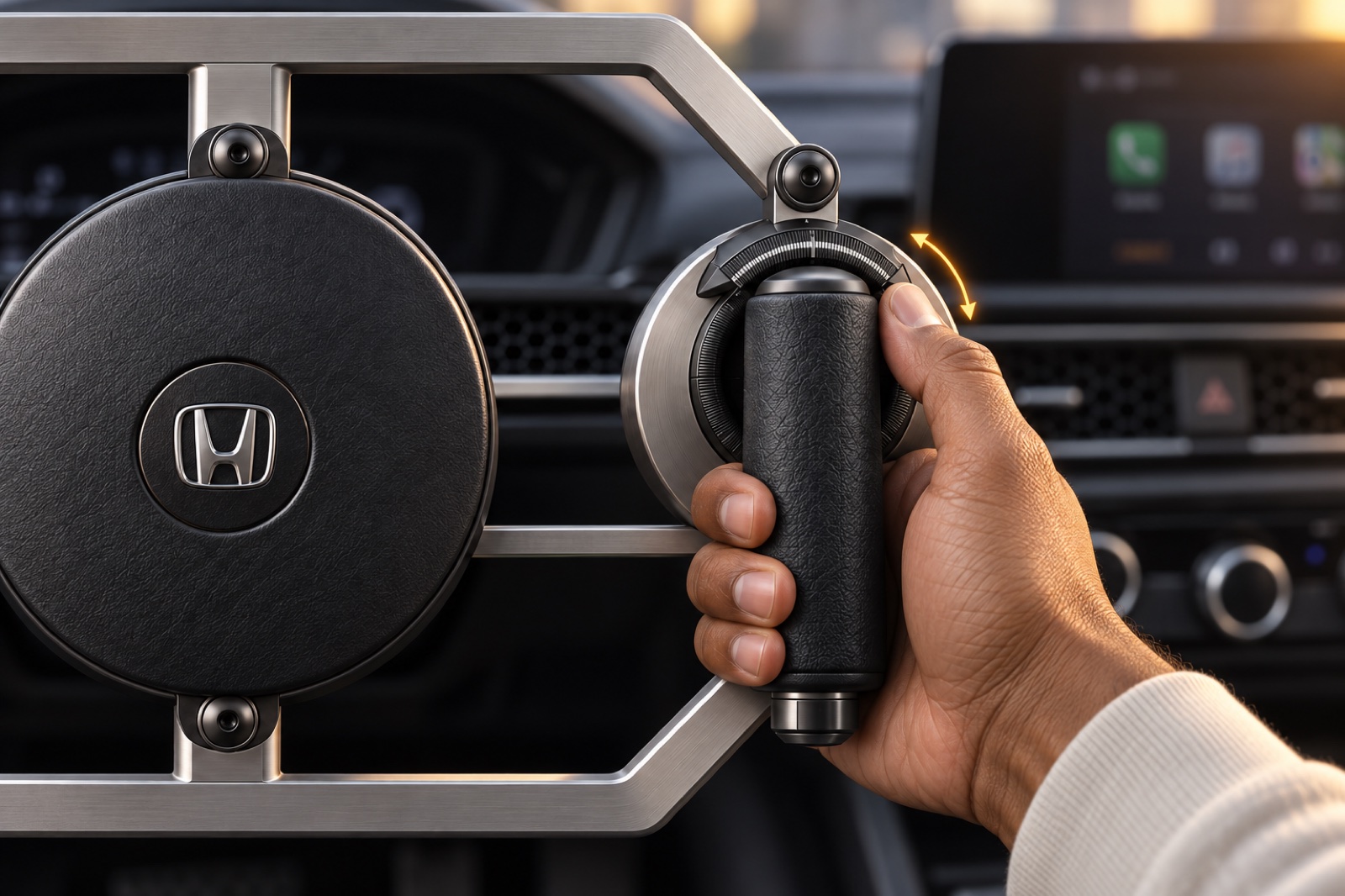
Either hand can request either function. There is no dedicated left-hand brake or right-hand accelerator, and the two controls are mechanically connected. Gears, pulleys and a toothed belt make one dial follow the other. An additional gear reverses rotation on one side so that outward movement at one hand produces matching outward movement at the other.
That connection prevents independent operation of the paired controls, which Honda identifies as a way to reduce mistaken inputs. It also keeps them coordinated when steering places the hands at different heights.
Springs resist dial movement and return the controls to neutral when released. While the vehicle is moving, Honda describes that neutral state as coasting. Letting go does not automatically command braking, an important distinction for anyone accustomed to strong regenerative deceleration after lifting off an EV’s accelerator.
The accessibility thinking extends beyond the linkage. Honda describes using different fingers when finger function is limited. Another version combines the grip and speed control into a twisting handle, with a support behind the hand so wrist movement can request acceleration or braking.
A Better Reason To Rethink The Wheel
Honda previously explored hand-operated speed control with its Augmented Driving Concept for CES, which accelerated when the steering wheel was pushed and slowed when it was pulled. The new proposal adds a way to preserve grip orientation while steering.
Other manufacturers are reconsidering the interface, too. Lexus specifies roughly 200 degrees from center to either full lock for the RZ steer-by-wire system introduced for Europe. Its compact wheel and variable steering ratio address how much the driver needs to turn. Honda’s articulated arrangement addresses how the hands are positioned while also controlling speed.
The unresolved questions are substantial. Honda has not confirmed measurable ergonomic benefits, how an airbag would integrate with the wheel or a complete response to a control-system failure while steering, accelerating or braking. It does allow position signals from both speed dials for fault detection, but that is only part of the engineering required. A patent does not guarantee production.
This is a stronger proposition as an aid to hand-operated driving than as a replacement for every conventional wheel. Keeping a secure grip while steering and braking is a concrete benefit to pursue. Demonstrating that drivers can do both more comfortably and reliably should determine whether this mechanism earns a place in a car.