

Porsche has filed a patent for an innovative rotor design that uses centrifugal force to circulate coolant through internal channels. This could eliminate the need for a separate cooling pump in separately excited synchronous motors (SESM). Submitted to the European Patent Office, the design aims to significantly enhance motor cooling and overall efficiency by integrating the cooling mechanism directly into the rotor structure.
Why Electric Motors Need Cooling
Just like EV batteries, electric motors must be actively cooled to prevent overheating during heavy use or in high ambient temperatures. Maintaining optimal operating temperatures is critical to ensure efficiency and long-term reliability. In high-heat scenarios, most systems require a separate coolant pump to deliver enough flow to manage the heat, at least intermittently.
Rotor-Driven Cooling: Porsche’s Self-Pumping Design
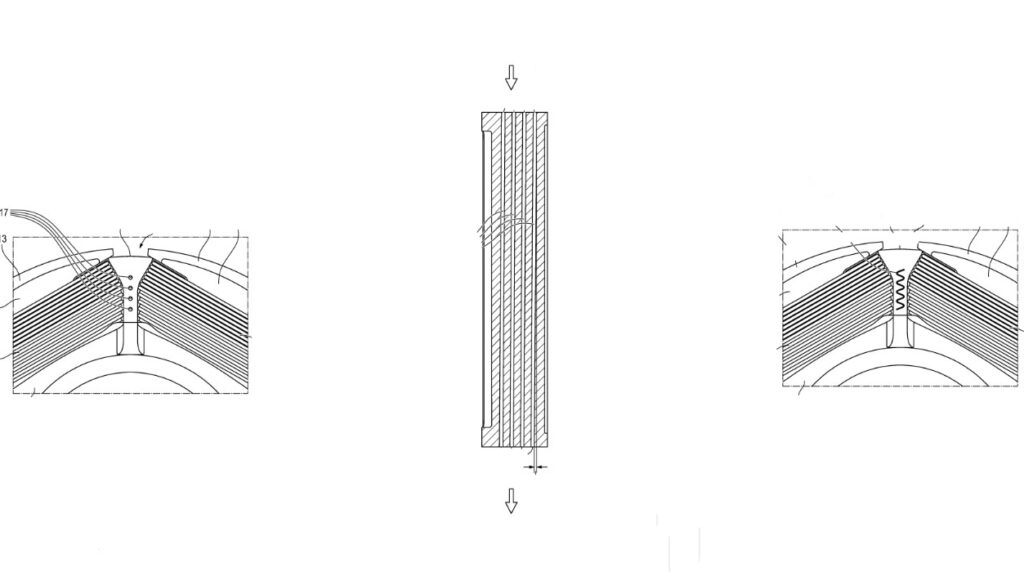
Porsche believes it can eliminate the need for a separate cooling pump by rethinking the rotor design of its electric motors. The new rotor incorporates specially formed channels during manufacturing, allowing coolant to be pushed outward by centrifugal force as the motor spins, effectively turning the rotor into its own pump.
Porsche outlines several possible channel geometries:
- Linear channels
- Wave-like channels
- Quadratic channels
The chosen configuration likely depends on the motor’s output, heat distribution, and specific cooling requirements.
Reducing Reliance on External Cooling Pumps
What sets Porsche’s patent apart is its use of rotor-integrated channels to function as a built-in coolant pump. While Porsche stops short of claiming this design can entirely replace a traditional cooling pump, it suggests that in many operating conditions, the rotor-driven flow may be sufficient on its own.
This could lead to greater overall efficiency and power savings, as the external pump would only need to activate under high thermal loads. Though not fully eliminated yet, the external cooling pump may become redundant in future iterations of this system.