
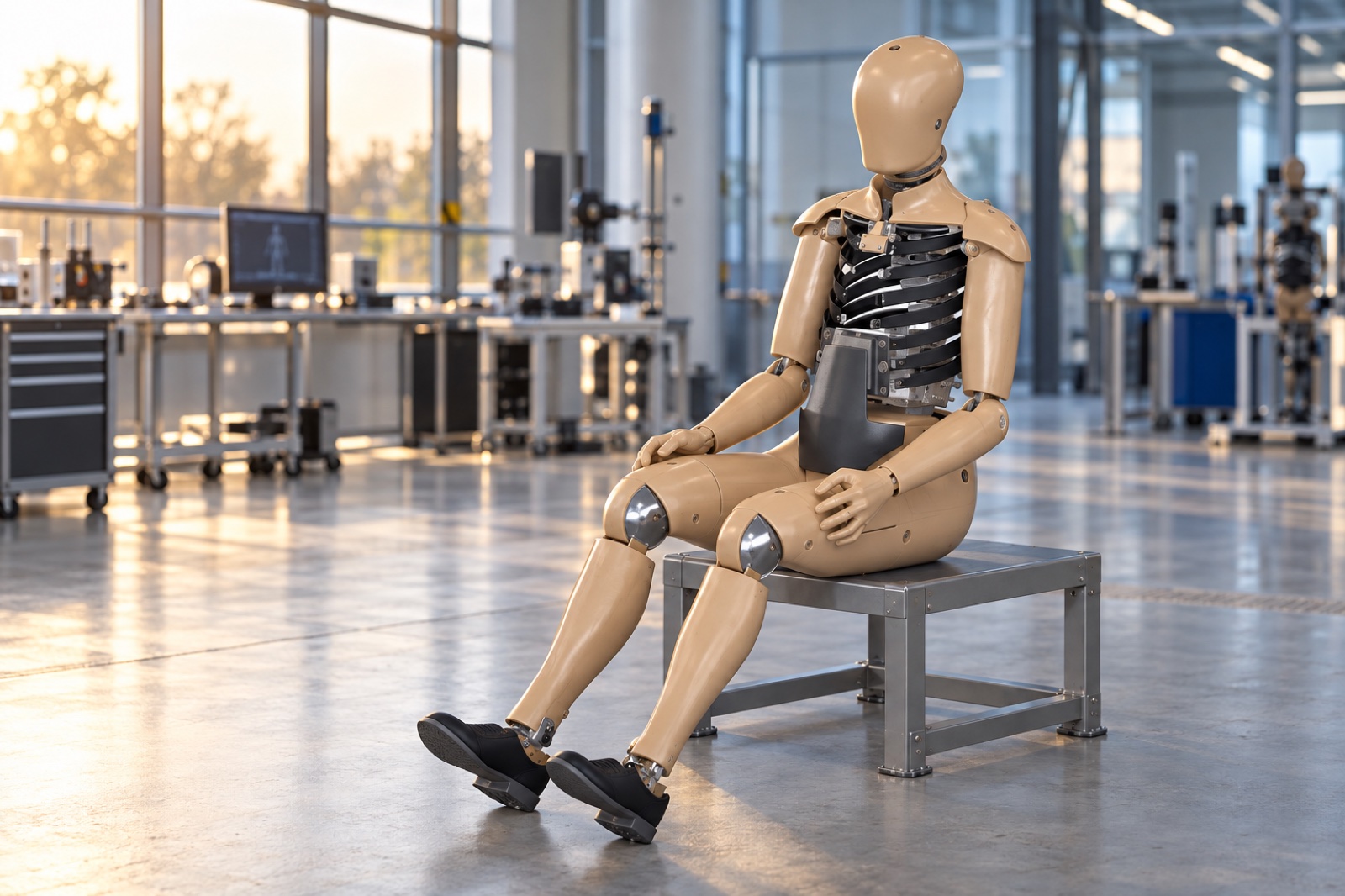
Crash-test dummies need impact tests of their own. For THOR-50M, the advanced dummy representing an average-size adult man, checking its face means allowing the foam beneath its skin 24 hours between qualification impacts. A replacement developed by Humanetics could remove that delay, according to a Federal Register notice reviewed by Carmoses.
NHTSA’s September 22 proposal would allow a 3D-printed insert as an alternative to the existing foam. Agency tests found more consistent responses without the recovery period, addressing a practical concern General Motors raised during the rulemaking. GM said the wait was impractical for organizations conducting a high volume of tests each week.
The benefit starts with the measuring equipment. Engineers need to know that changes in a dummy’s readings reflect the impact being studied, rather than a face insert that responds differently after repeated use. That is why this small component deserves attention beyond the laboratory.
What Happens Beneath the Skin
The existing memory foam fits between THOR’s outer head skin and the force sensors mounted on its skull. During qualification, a rigid impactor strikes the face. Technicians check the impact force and head acceleration against specified limits to establish that the assembly responds as intended.
Repeated impacts progressively change the foam’s response. Fresh foam sometimes needs several conditioning strikes to bring its readings into the acceptable range. Eventually, further impacts push those readings beyond the upper limit and the foam needs replacement. The recovery interval allows it to recover partially between tests.
Humanetics’ alternative uses thermoplastic polyurethane, formed into an outer shell with patterned material inside. It occupies the cavity beneath the existing head skin. The printed component replaces the cushioning insert, leaving the outer skin as a separate part.

NHTSA evaluated three inserts and reported improved consistency both between repeated tests and across the samples. They did not require the foam’s conditioning strikes or its 24-hour recovery period. Higher-energy durability testing also left the inserts undamaged, with their subsequent qualification responses unchanged.
Laboratories using foam still have options. NHTSA says they can carry out other qualification tests during the recovery interval or swap in another insert. The proposal therefore addresses a specific preparation burden, rather than eliminating a mandatory day of downtime for the entire dummy.
The agency also proposes retaining the face-impact check. Mercedes-Benz and the Alliance for Automotive Innovation previously suggested following Euro NCAP’s visual-inspection approach instead. NHTSA’s objection is concrete: foam can look intact yet respond outside the permitted range. A face impact can affect the head-acceleration measurements used to assess head injury risk.
Four Positions, With a Practical Purpose
The same notice proposes an optional Humanetics spine with four fixed settings: erect, neutral, slouched and super slouched. It brings the proposed US specification closer to the configuration used by Euro NCAP and provides mounting space for onboard data recorders.
Those postures are already available with the original spine, which adjusts in three-degree increments. The change concerns how technicians set the position and accommodate recording equipment. Industry commenters described easier adjustment and less risk of positioning errors with the four-position design.
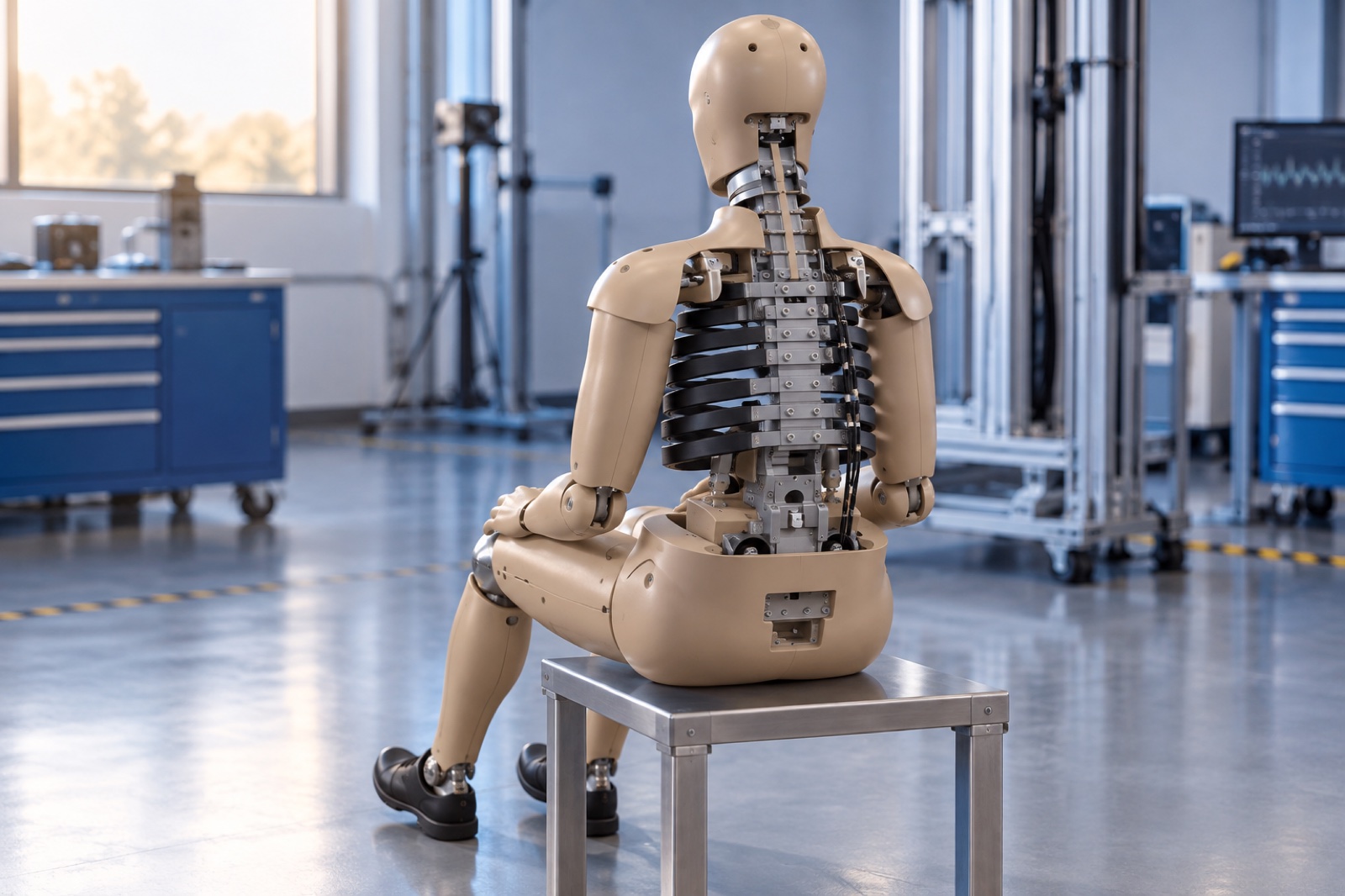
Render: This illustrative rear view follows existing hardware rather than reconstructing the proposed spine.
NHTSA’s evaluation of the Humanetics configuration included qualification, sled and vehicle crash tests. The agency found results equivalent to those from the original spine within expected test variation. The original spine would remain available with an external recording system.
A smaller drawing update covers an upper-arm mounting component that Humanetics revised in 2018 to address durability. NHTSA found the updated part’s movement and durability acceptable.
What US Buyers Actually Gain
THOR’s development stretches well beyond this proposal. NHTSA published an initial design in 2001, following the older Hybrid III male dummy’s addition to federal dummy regulations in 1986. THOR was developed to reproduce human crash responses more closely and provide richer measurements for evaluating occupant protection. This rulemaking began in September 2023.
The current notice defines test equipment. It does not require THOR’s use in federal compliance or consumer-rating tests, change a car’s safety rating or call for an owner repair. The value for buyers lies further upstream, in the tools engineers use to assess restraint systems.
Further testing of the face insert, including crash testing, is planned before a final rule. Comments close October 22, 2026. Retaining an objective impact check while making the insert more consistent is the right approach. On the evidence NHTSA reports, this is a useful improvement to the equipment behind vehicle safety testing.