
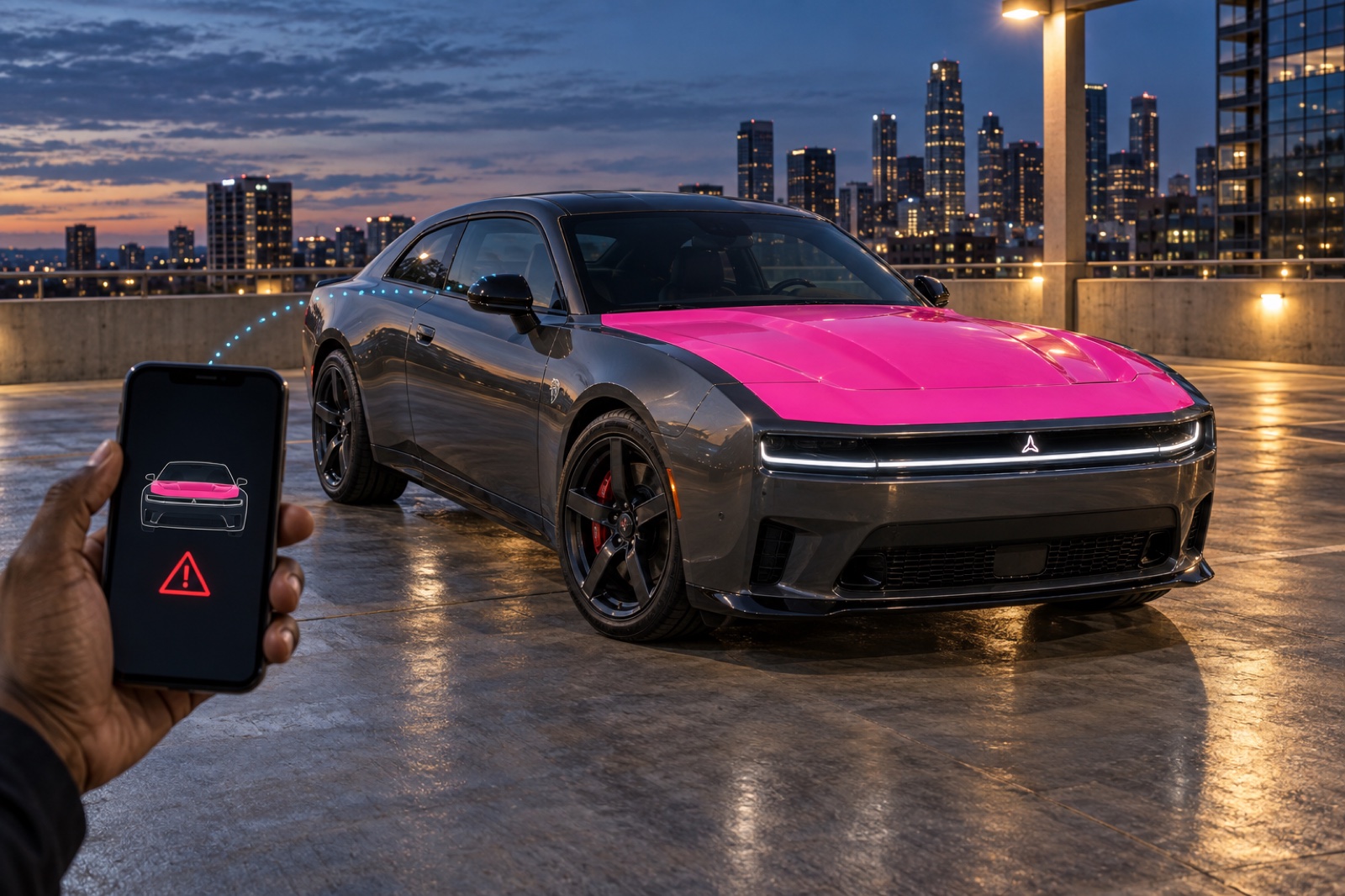
Picture a thief rolling up to a stoplight in your dark gray Charger, trying to look perfectly ordinary. Then the hood turns hot pink. The car has just become a much easier one to remember.
Dodge’s parent company, Stellantis, proposes that kind of conspicuous transformation, according to a patent filing discovered by Carmoses. An owner’s remote request or information from a stolen-vehicle database would tell the car to change the color of part of its bodywork. Pink is among the suggested choices, alongside yellow and green.
The Charger is an obvious home for the idea. Dodge has already tackled owners’ theft concerns with security measures for earlier Chargers and Challengers, including restrictions on programming new keys. Giving a stolen muscle car a hood that practically waves at passing traffic adds a wonderfully visible layer to that effort.
The Hood Rats You Out
Start with the miserable moment you discover your parking space is empty. Through a dedicated phone app or website, you would send the car a theft report. Someone you have authorized to control the vehicle remotely could do the same.
There is a second route, too. The car could check a database of stolen vehicles, with police supplying the information. Those checks could happen at regular intervals or when the database changes.
Once that information reaches the car, its electronics switch from normal status to a theft alert. A controller sends an electrical signal to the active body surface, changing its appearance. The trigger is the incoming report, so the owner does not have to catch the thief in the act or stand within key-fob range.
Only part of the body needs the special surface. A hood, rear lid or roof would do, and even a section of one of those panels can carry it. That makes a Charger’s broad hood an appealing canvas. A dark car gets a conspicuous patch that a driver in the next lane can pick out.
Your Hood Gets An E-Reader’s Party Trick
One proposed way to do this uses electrophoretic ink, the family of technology behind electronic-paper displays. An electric field moves tiny colored particles, changing which color is visible at the surface. The panel stays the same shape. Its finish does the moving.

Think of an e-reader turning a page, with a much bigger audience. Once the particles have moved, the ink can hold that appearance without a continuous supply of power to maintain the color. The car’s communications and control electronics still need electricity.
BMW made color-changing bodywork famous with its black-and-white iX Flow demonstration in 2022, and technology firm Adeia has already explored changing stolen cars’ colors to make them stand out. Stellantis brings the idea into a group whose American muscle-car customers already have plenty of reasons to care about theft.
There is another useful twist. The active surface can also display a message visible outside the car. That gives an unusual color some meaning. Plenty of enthusiasts already order bright paint jobs on purpose, so a warning message helps distinguish an alert from a customer’s own color choice.
The Nicest Color Is The One You Get Back
Once an owner sends a theft report, the change can happen anywhere the car is, not just within reach of a key fob. A car spotted blocks or towns away becomes easier to identify and report than an unmarked “gray Dodge.”
The appeal extends across the Charger family. Dodge now offers both gasoline and electric versions, and an electrically controlled warning panel has a job to do with either powertrain. It fits the same basic wish that makes tracking services attractive, giving the owner another way to make a missing car easier to find.
After recovery, the change can run in reverse. The alert color disappears and the original appearance returns, without repainting the panel to erase the warning.

Carmakers patent far more than they build, but a reversible warning panel gives color-changing bodywork a persuasive everyday job.

