
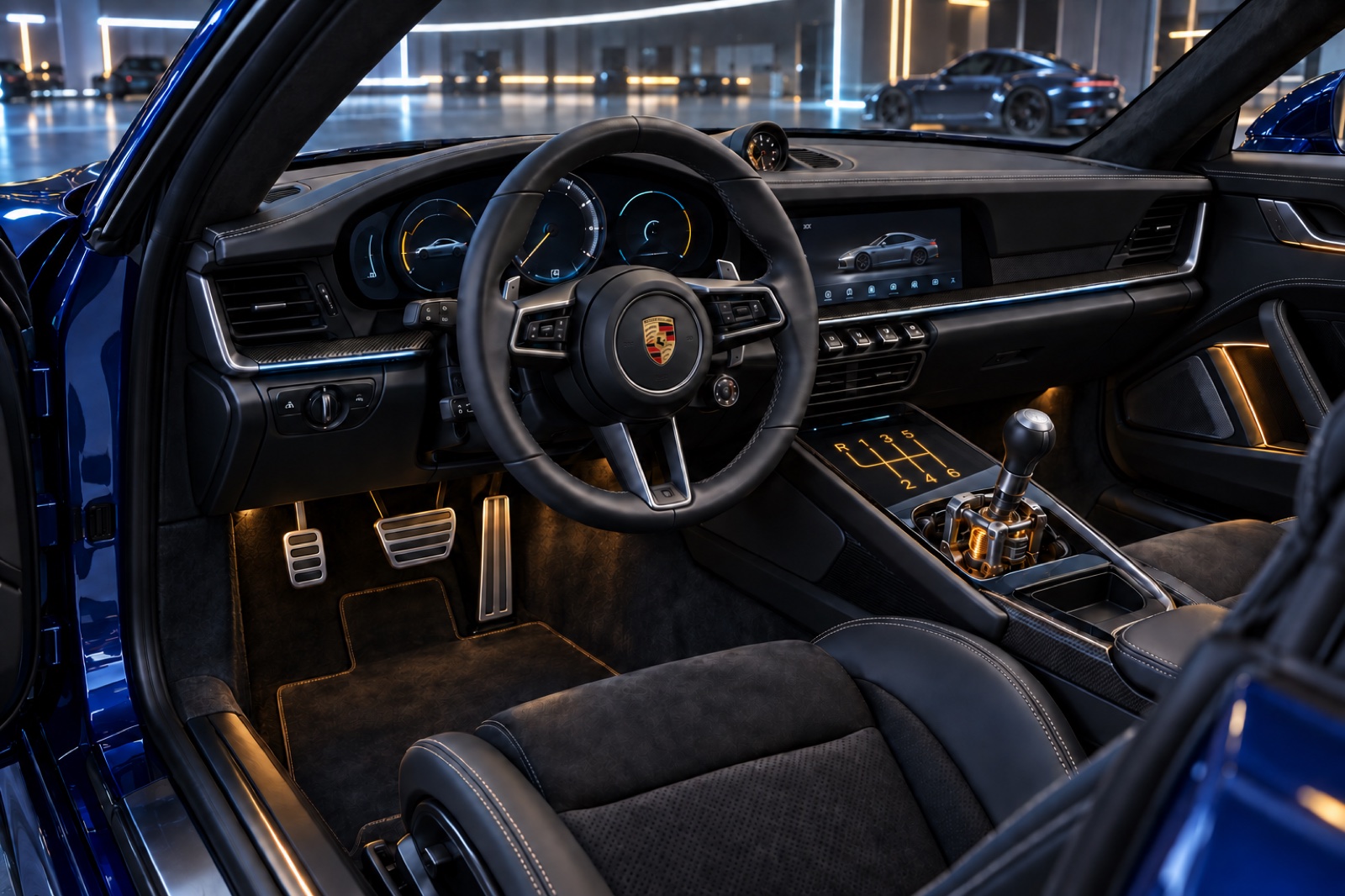
Flick the gear lever for a quick upshift and it springs back to center. Change modes, work the clutch pedal and slot that same stick into an H-pattern: now it stays where you left it, just as your right hand expects.
Porsche wants to give an automatic that physical transformation, according to a patent filing reviewed by Carmoses. Its proposed setup combines automatic shifting, sequential changes and clutch-and-stick driving in one combustion-powered car. The extra pedal even lets you disconnect the engine from the wheels while the car is in automatic mode.
Porsche floated a shifter that flips between automatic and H-pattern operation earlier this year. This idea adds the missing piece, a third pedal, and the appeal is easy to understand: choose how much work you want to do after you’ve bought the car, rather than at the dealership.
Porsche’s reasoning is refreshingly human: sporty-car drivers accustomed to manuals find automatics less sporty and less emotional, even with two clutches doing the shifting. The aim is to make the driver feel like they’re driving a manual.
A Gear Lever With Three Personalities
Start with the everyday setting. The stick selects reverse, neutral or drive, returning to its resting position after you move it. Porsche’s preferred setup gives it two distinct resistance points in each direction, so your hand can feel how far you’ve pushed.
Choose sequential mode and that changes to one resistance point in each direction. Push or pull to request the next gear, let go, and the lever centers itself again. The paddles behind the steering wheel handle the same up-and-down shifting duties.
Then comes the clever bit. In the third mode, the stick moves through parallel lanes joined across the middle, the familiar H-pattern of a manual. It stays at the end of the selected lane instead of springing home. The sideways movement between lanes and the fore-and-aft throw into gear are tailored to feel like a manual, too.
The proposed manual layout places first, third and fifth forward, with second, fourth and sixth behind them. Reverse sits on its own dogleg to the left of first.

Porsche’s suggestion for creating those sensations is magnetorheological actuators inside the shifter. They use fluid whose resistance changes under a magnetic field, the same fluid trick used in some adaptive dampers, to alter how the stick feels as you move it. Electromagnetic actuators would do the job, too. Think of the force feedback in a racing simulator’s steering wheel, applied to the stick: electronics give your hand something physical to push against.
That matters because part of a satisfying manual shift happens before the clutch comes back up. Your hand feels the movement across neutral, the resistance entering the next gear, then the lever coming to rest. Porsche wants control over that whole little sequence.
A rotary-push switch on the steering wheel would choose the mode: turn to select, press to activate.

Your Left Foot Gets A Say, Even In Drive
The third pedal has more to do than wait for a favorite stretch of road. In automatic mode, press it beyond a set point and the car opens the link between engine and wheels, allowing it to roll without engine drive. Release the pedal and drive reconnects. The same function works in sequential mode.

Switch to H-pattern operation and the pedal takes on the clutch role, with gear changes depending on both your foot and the lever. Their inputs reach the transmission’s electronic controller, which coordinates with the engine controller to carry out the change. Your limbs supply the timing and requests; the car operates the gearbox.
The paddles get a new job in this clutch-and-stick mode: they can retune the shift feel to make it sportier.
A dual-clutch automatic is the natural fit. It divides its gears between two sections, each with its own clutch, making a PDK-style installation an obvious route. Porsche’s idea also accommodates a conventional torque-converter automatic and a hybrid powertrain.

The standard to aim for is a good conventional manual: a pedal and lever that make a well-timed shift feel rewarding.
Sportomatic, Meet Your Opposite
Porsche has spent decades rearranging the relationship between left foot and right hand. In 1967, the 911’s semiautomatic Sportomatic removed the clutch pedal to make life easier. This idea brings it back to an automatic so the driver can choose a little more involvement.
Koenigsegg has already made that choice part of the CC850’s appeal. Its Engage Shift System combines a gated six-speed manual experience, complete with clutch pedal, and nine-speed automatic operation.

A 911 is the obvious home for Porsche’s approach; even Porsche’s own sketch uses an unmistakably 911-shaped coupe. The brand announced a six-speed manual Carrera S for North America in August, alongside the eight-speed PDK version, citing customer demand.
Carmakers patent far more than they build, but this is an appealing way to put weekday convenience and Sunday ritual in the same garage space.

